

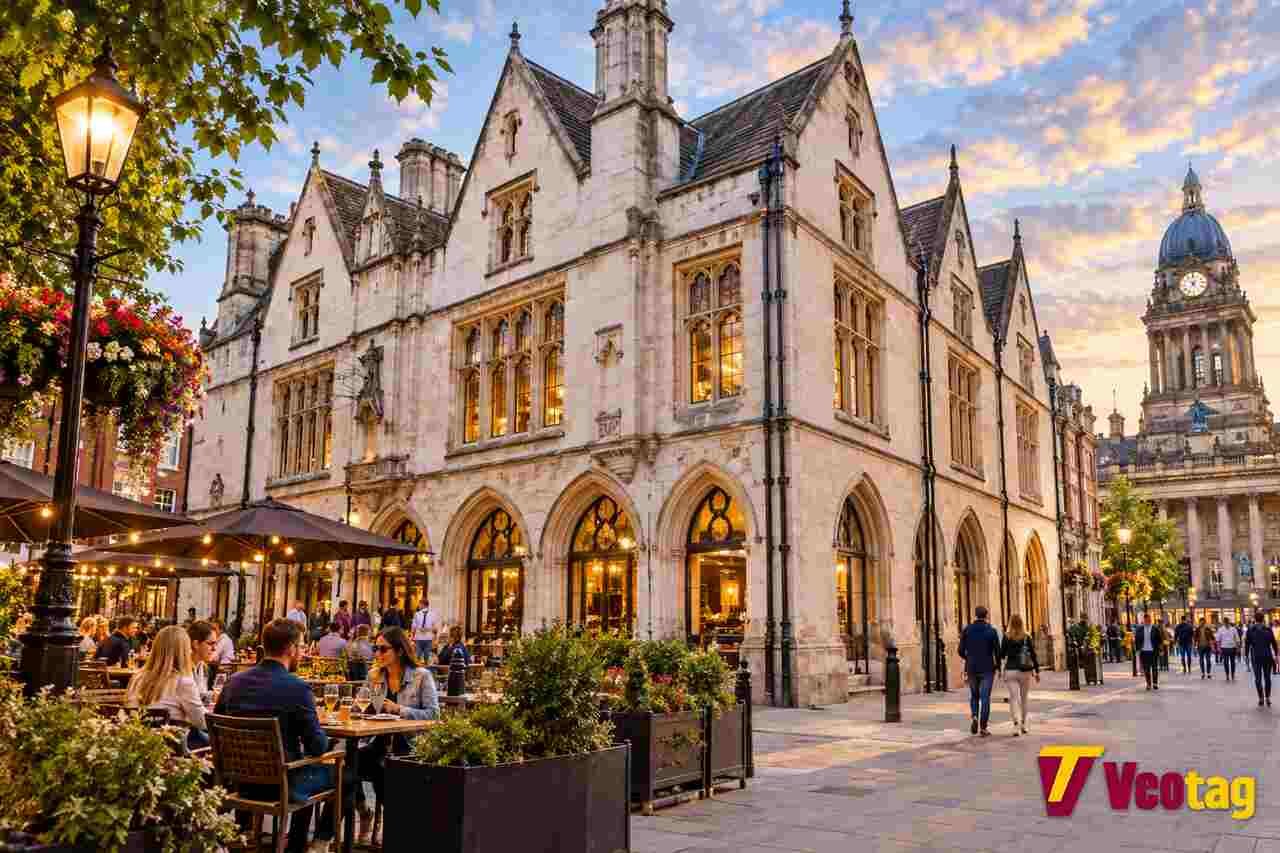
White Cloth Hall Leeds is a restored historic building at 27 Crown Street, near Leeds Kirkgate Market. Today, it operates as an all-day food and drink hall with four independent kitchens, bars, weekend brunch, indoor and outdoor seating, and event space, combining Leeds’ textile-trading heritage with a modern dining experience.
White Cloth Hall Leeds at a Glance
| Detail | Information |
| Address | 27 Crown Street, Leeds LS2 7DA |
| Type | All-day food and drink hall |
| Independent kitchens | Four |
| Food styles | Mexican, Italian/Sicilian-inspired, East Asian, British grill and seafood |
| Drinks | Craft beer, cask ale, wine, coffee and cocktails |
| Weekend brunch | Saturday and Sunday |
| Indoor capacity | Around 350 seats |
| Outdoor capacity | Around 90 seats |
| Monday | Closed |
| Advance bookings | Available at selected times |
| Large groups | Enquiries available for groups of 12+ |
Opening arrangements and individual traders can change, so it is worth checking the venue’s current information before making a special journey.
What Is White Cloth Hall Leeds?
White Cloth Hall is a restored historic cloth hall that now operates as a contemporary food and drink destination in Leeds city centre.
The venue describes itself as an all-day food and drink hall and is operated by the team behind Whitelock’s Ale House. Its present format brings several independent kitchens together with a main bar and dedicated wine offering, allowing a group to share the same table without everyone having to order from the same kitchen.
That arrangement is particularly useful for mixed groups. Someone can choose tacos while another person orders steak, pizza or East Asian food, rather than the entire table being restricted to one restaurant menu.
The building itself gives the venue another dimension. The surviving White Cloth Hall is connected to the period when Leeds developed into an internationally significant centre of the cloth trade. Historic England records the surviving Crown Street remains as Grade II* listed.
Food at White Cloth Hall
White Cloth Hall currently brings together four independent kitchens rather than operating as a conventional single-menu restaurant. The line-up covers noticeably different styles of food, which is one of the venue’s main practical advantages for groups.
Salma Modern Mexican
Salma Modern Mexican focuses on Mexican-inspired food, with the venue highlighting dishes such as tacos and ceviche. It provides one of the lighter and more vibrant alternatives to the meat-focused options elsewhere in the hall.
Morty’s Focacceria
Morty’s brings Italian and Sicilian influences to White Cloth Hall. Its offering includes Panuozzi and Sicilian pizza slices, making it a useful option for visitors looking for more casual food rather than a traditional sit-down restaurant meal.
Lupton’s Chop House
Lupton’s Chop House concentrates on British grill and seafood dishes. White Cloth Hall specifically highlights steak from the grill and oysters among its offering.
The kitchen has also been used for special dining events. In April 2026, for example, Lupton’s was selected for the first event in White Cloth Hall’s monthly Supper Club series, with a six-course menu built around seasonal British dishes, live-fire cooking and seafood.
RAKKU East Asian Kitchen
RAKKU completes the current four-kitchen line-up with East Asian food. This gives groups another distinct choice alongside Mexican, Italian-influenced food and the British chop-house offering.
Menus can change, so visitors looking for a particular dish should check the live or current menu rather than relying on an older menu found online.
Drinks, Wine and Coffee
White Cloth Hall is as much a drinking destination as a food hall. The main bar serves craft beer and cask ale, while a separate wine bar gives visitors an alternative to the main hall’s beer-focused offering. Coffee and breakfast cocktails are also part of the weekend brunch service.
This makes the venue flexible across the day. A visit might be for coffee and brunch in the morning, lunch during a day in Leeds, after-work drinks, or food and drinks later in the evening.
The separate kitchen and bar hours are worth remembering. Food service can finish before the main bar closes, so arriving late in the evening for drinks does not necessarily mean all kitchens will still be serving.
Weekend Brunch at White Cloth Hall
White Cloth Hall runs brunch sessions on both Saturday and Sunday, beginning at 10:30am. The venue’s published brunch information includes dishes such as Eggs Benedict, pancakes, bacon sandwiches, steak and eggs, huevos rancheros and Morty’s Breakfast Stack, although the exact menu can change.
Brunch is also one of the occasions when advance booking is particularly relevant. White Cloth Hall accepts weekend brunch bookings between 10:30am and 1pm.
For visitors planning a Saturday trip, that distinction matters because normal Saturday bookings are not taken outside the brunch period according to the venue’s current booking policy.
White Cloth Hall Leeds Opening Times
The venue has different opening times for its main bar, kitchens and wine bar.
| Day | Main Bar | Kitchens | Wine Bar |
| Monday | Closed | Closed | Closed |
| Tuesday | 12pm to 11pm | 12pm to 9pm | 5pm to 11pm |
| Wednesday | 12pm to 11pm | 12pm to 9pm | 5pm to 11pm |
| Thursday | 12pm to 11pm | 12pm to 9pm | 5pm to 11pm |
| Friday | 12pm to 11pm | 12pm to 10pm | 5pm to 11pm |
| Saturday | 10:30am to 11pm | 10:30am to 10pm | 12pm to 11pm |
| Sunday | 10:30am to 9pm | 10:30am to 8pm | 12pm to 9pm |
These are the venue’s published hours at the time of writing. Bank holidays, private events and other circumstances may affect opening times, so checking before travelling is sensible.
Do You Need to Book White Cloth Hall?
Not necessarily. White Cloth Hall welcomes walk-ins and states that it has around 350 indoor seats plus another 90 seats outside.
Advance bookings are currently accepted Tuesday to Friday, on Sundays, and for weekend brunch between 10:30am and 1pm. Saturdays work differently: outside the brunch period, the venue does not take standard Saturday bookings.
For groups of 12 or more, White Cloth Hall asks visitors to make a large-group enquiry. Private-hire enquiries are also handled separately. This is more practical than relying on a walk-in when organising a birthday, work gathering or other event involving a substantial number of people.
Where Is White Cloth Hall in Leeds?
White Cloth Hall is at:
27 Crown Street
Leeds
LS2 7DA
Its city-centre location puts it in Leeds’ historic market quarter and makes it practical to combine with shopping, sightseeing or an evening in the centre.
The location also helps explain the building’s historical significance. This part of Leeds was closely associated with the city’s commercial development and cloth trade, although today’s venue should not be confused with the earlier First White Cloth Hall on nearby Kirkgate.
The History Behind White Cloth Hall
The White Cloth Hall at Crown Street dates from the 1770s. The venue describes the building as first built in 1775, while Historic England records the surviving hall as having opened in 1776. The difference reflects the distinction between construction and opening rather than indicating two unrelated buildings.
The Crown Street building was Leeds’ third White Cloth Hall.
Its predecessors reflected the rapid growth of the local textile trade. Leeds’ first dedicated hall for undyed white cloth opened on Kirkgate in 1711. A second hall followed in Meadow Lane in the 1750s as the trade expanded. Historic England notes that by this period around 4,000 to 5,000 clothiers were attending Leeds’ cloth halls each week.
Merchants financed the third White Cloth Hall during the 1770s. It originally consisted of four ranges arranged around a rectangular courtyard. Historic England records that approximately three-quarters of the cloth passing through Leeds during this period was exported, demonstrating how closely the hall was connected to a much larger international trade.
The complex was not solely a place for commercial transactions. The adjoining Assembly Rooms became an important social venue for Leeds’ merchant class, with facilities including a ballroom, gaming rooms and refreshment rooms.
Why Only Part of the Historic Cloth Hall Survives
Visitors today are not seeing the complete 18th-century complex.
The development of factory-based cloth processing contributed to the decline of traditional cloth halls during the 19th century. A major physical change followed in 1865, when construction of a railway viaduct resulted in the demolition of a substantial part of the White Cloth Hall.
What remains includes part of the north-west range and entrance on Crown Street. Historic England describes ten arches surviving from the former west range and records the structure as Grade II* listed.
That surviving fabric makes the modern food hall more than a themed redevelopment. Visitors are using part of a building directly associated with the commercial infrastructure that supported Leeds’ rise as a textile centre.
White Cloth Hall vs First White Cloth Hall: Know the Difference
Searching for “White Cloth Hall Leeds” can produce information about two different historic locations.
The modern food and drink venue at 27 Crown Street occupies surviving elements associated with the third White Cloth Hall, which opened in the 1770s.
The First White Cloth Hall, meanwhile, is at 98-100 Kirkgate. It dates from 1711 and is also Grade II* listed. Historic England describes it as the first cloth hall built in Leeds specifically for producers of undyed cloth.
The first hall was created partly in response to competitive pressure from Wakefield, where a covered cloth hall had been developed. Leeds merchants wanted a secure, sheltered trading place of their own. The Kirkgate building eventually fell into serious disrepair, but a regeneration project involving Rushbond, Historic England, the National Lottery Heritage Fund and Leeds City Council helped secure its future.
So, if you are looking for food, drinks or brunch, 27 Crown Street is the White Cloth Hall you want. If your main interest is the earliest surviving history of Leeds’ purpose-built cloth halls, 98-100 Kirkgate is the First White Cloth Hall.
Is White Cloth Hall Worth Visiting?
White Cloth Hall makes most sense for visitors who want choice rather than the fixed experience of a single restaurant. Four independent kitchens mean people with different preferences can order different types of food while still eating together. The bars and large seating capacity also make it practical for social gatherings.
Its historic surroundings provide another reason to visit. The surviving Grade II* listed fabric connects the venue with the period when textile commerce was central to Leeds’ economic development.
There are limitations to consider. Individual kitchen hours differ from bar hours, menus change, and standard advance bookings are unavailable on Saturdays outside brunch. Anyone travelling specifically for one kitchen or dish should check the latest menu and opening information first.
For people who enjoy combining food with local history, however, White Cloth Hall offers something that a newly built food court cannot easily reproduce: the opportunity to eat and drink within the remains of a site created for Leeds’ historic cloth economy.
Planning Your Visit
For a straightforward visit, decide first whether you want brunch, lunch, dinner or primarily drinks. That affects both the best arrival time and whether a reservation is possible.
Weekend brunch can be booked, while Saturday visits later in the day generally operate on a walk-in basis. Larger parties should contact the venue in advance rather than assuming that the large overall capacity guarantees a suitable group table.
If you’re interested in the history as well as the food, allow some time to explore the surrounding Kirkgate area. The proximity of the First White Cloth Hall helps put the Crown Street building into context and shows how Leeds’ cloth-trading infrastructure expanded as the industry grew.
FAQ’s
It is better described as a food and drink hall than a single restaurant. Four independent kitchens operate within the venue, alongside a main bar and wine bar.
The current kitchen line-up includes Salma Modern Mexican, Morty’s Focacceria, RAKKU East Asian Kitchen and Lupton’s Chop House. The choices range from tacos and Italian/Sicilian-inspired food to East Asian dishes, steak and seafood. Menus can change.
Yes, at selected times. Advance bookings are currently available Tuesday to Friday, Sundays, and during weekend brunch sessions. Standard Saturday bookings outside brunch are not offered. Groups of 12 or more can submit a large-group enquiry.
No. The published opening hours list the main bar, kitchens and wine bar as closed on Mondays.
The Crown Street White Cloth Hall dates from the 1770s and opened in 1776 according to Historic England. It was the third White Cloth Hall in Leeds. The city’s much earlier First White Cloth Hall on Kirkgate opened in 1711.
The food and drink hall is at 27 Crown Street, Leeds LS2 7DA. Do not confuse it with the First White Cloth Hall at 98-100 Kirkgate, which is a separate historic building.
Final Thoughts
White Cloth Hall Leeds combines two sides of the city in one place: its historic textile-trading past and its modern independent food and drink scene. The Crown Street venue offers four kitchens, beer, wine, weekend brunch, substantial seating and options for larger gatherings, all within surviving fabric associated with the city’s 18th-century cloth trade.
For most visitors, the practical choice is simple. Check the latest kitchen hours and menus before travelling, book where the venue allows it, and remember that Saturday outside brunch is generally walk-in. If Leeds’ history interests you, also look beyond the food hall itself. The nearby First White Cloth Hall on Kirkgate helps tell the earlier part of the story and shows how rapidly the city’s cloth trade expanded during the 18th century.
Read Also: Flat Iron Leeds: Menu, Location, Opening Times and What to Expect
