







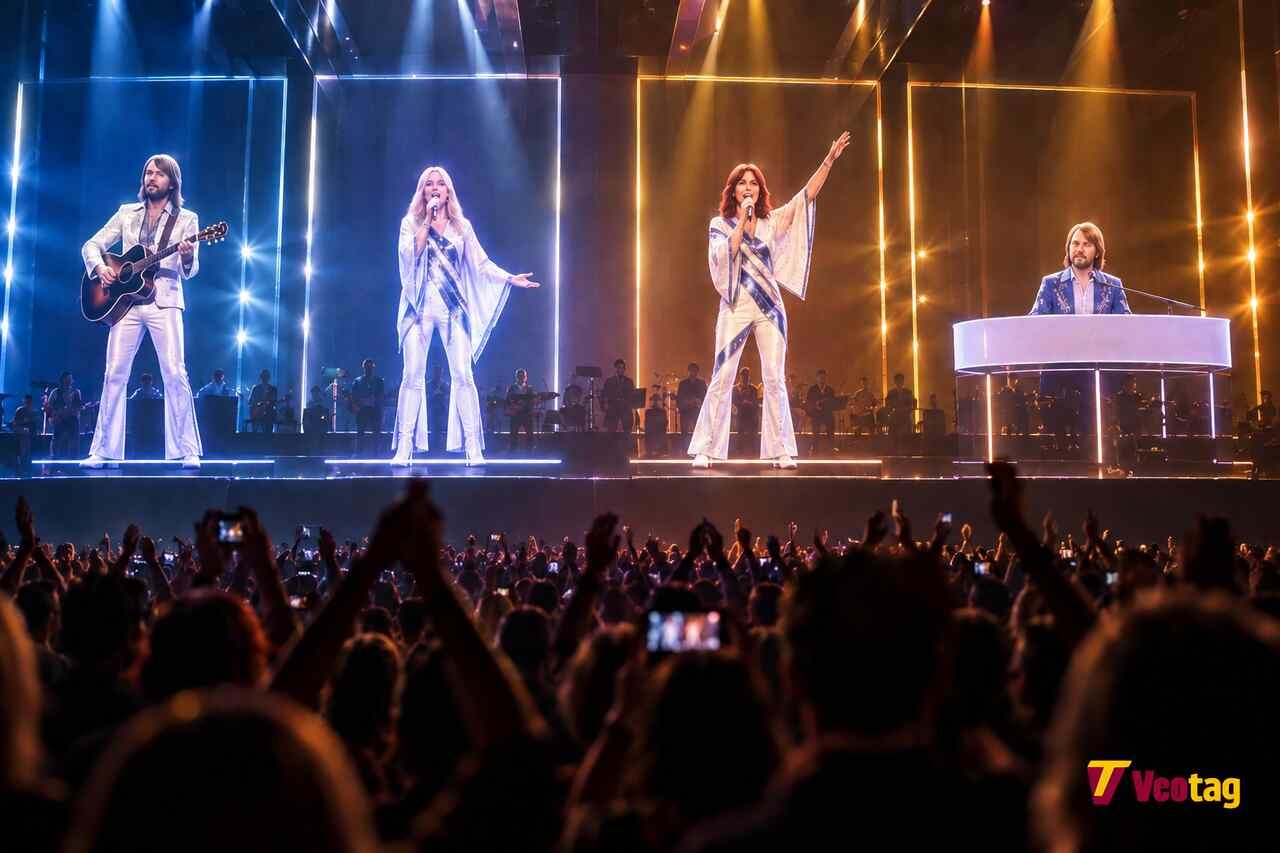
ABBA Voyage brings ABBA back to the stage as remarkably convincing digital versions of their younger selves, supported by a live band and spectacular production. More than a technological novelty, the show creates an immersive concert experience that makes it easy to forget the four members are not physically performing.
ABBA Voyage Review at a Glance
| Category | Verdict |
| Digital ABBA performance | Remarkably convincing |
| Music | Classic ABBA backed by a live band |
| Visual production | The show’s biggest strength |
| Atmosphere | Celebratory and highly audience-driven |
| Dance Floor | Best for an energetic concert experience |
| Seated tickets | Better for comfort and taking in the complete production |
| Running time | About 100 minutes, no interval |
| Location | ABBA Arena, Queen Elizabeth Olympic Park, London |
| Best for | ABBA fans, couples, groups, families with older children, music and technology fans |
| Main drawback | The four members of ABBA are not physically performing |
| Overall verdict | A technically extraordinary show that works emotionally as well as visually |
The concert takes place at the purpose-built ABBA Arena in Queen Elizabeth Olympic Park. According to the official ABBA Voyage information, the performance lasts approximately 100 minutes without an interval. ABBA themselves do not physically appear in the nightly performance.
What Is ABBA Voyage Actually Like?
ABBA Voyage is neither a conventional tribute concert nor simply a giant film projected in front of an audience. Digital versions of Agnetha Fältskog, Björn Ulvaeus, Benny Andersson and Anni-Frid Lyngstad appear to perform on stage, accompanied by live musicians and an elaborate system of lighting, screens and effects.
The production was created using performance and motion-capture work involving the members of ABBA. The result depicts the group in its younger years rather than presenting the musicians as they look today.
That distinction matters. Calling the performers “holograms” does not adequately describe what the audience sees. The illusion depends on digital imagery working together with the physical stage, live musicians, lighting, sound and the architecture of the arena.
Contemporary professional reviews were exceptionally positive about the effect. The Guardian’s opening-night review gave the show five stars and described the visual result as “jaw-dropping,” noting how difficult it could become to perceive the figures as anything other than performers standing on stage.
That remains the key to understanding the experience. ABBA Voyage is not impressive simply because its digital performers look realistic. It works because everything around them helps sustain the illusion.
How Realistic Are the ABBA Avatars?
This is probably the biggest question for anyone considering a ticket.
From normal audience viewing distances, the digital ABBA members can be remarkably persuasive. Their movements, costumes and interaction with the stage have been designed to resemble an actual concert rather than four characters standing rigidly inside a digital display.
There can still be moments when the illusion feels less perfect, particularly when attention shifts toward large close-up imagery. The Guardian’s reviews noted occasional slightly unnatural qualities while still praising the production as an extraordinary technical achievement.
But absolute photorealism is not really the point.
Imagine watching a visually elaborate stage musical. You know the scenery is constructed, yet that knowledge does not stop you becoming involved in the performance. ABBA Voyage achieves something similar. Once the lighting, live band, audience and familiar songs are working together, your attention moves from How did they create that? to This feels like an ABBA concert.
That psychological shift may be the show’s cleverest trick.
The Live Band Makes a Bigger Difference Than You Might Expect
The presence of real musicians prevents ABBA Voyage from feeling like a sophisticated cinema screening.
The digital ABBA performances provide the focus, but live musicians give the room much of its concert energy. The Guardian’s review highlighted the contribution of the live band and the show’s powerful surround sound as important parts of the production.
This creates an interesting mixture of fixed and spontaneous elements.
The central ABBA performance has obviously been meticulously constructed. The audience, however, is completely real. So are the musicians playing in the arena. Thousands of people singing, cheering and dancing introduce the unpredictability that makes a concert feel communal.
That helps explain why watching clips online cannot reproduce the experience particularly well. The spectacle is designed around being inside the room.
The Songs Turn a Technology Demonstration Into a Concert
A weaker catalogue could expose the production as a technological experiment. ABBA’s catalogue does the opposite.
Songs such as “Mamma Mia,” “Waterloo,” “Fernando,” “Chiquitita” and “Dancing Queen” give the audience material it already knows intimately. The show can therefore move quickly between spectacle, nostalgia and mass participation instead of spending its entire running time demonstrating its digital effects.
The set also reaches beyond the most obvious party songs. That helps the concert feel like a carefully constructed ABBA performance rather than a greatest-hits playlist accompanied by expensive visuals.
The final stretch is particularly suited to the communal nature of the experience. The Guardian’s opening-night assessment observed that by the finale of “Thank You for the Music” and “Dancing Queen,” the distinction between watching ABBA and watching representations of ABBA had largely lost its importance.
That is arguably the best measure of whether the concept succeeds.
Dance Floor vs Seats: Which ABBA Voyage Tickets Should You Choose?


Your ticket location can significantly change the experience.
The Dance Floor is the stronger choice if your priority is dancing, singing and experiencing the production like a pop concert. It is general admission and gives the audience freedom to move rather than remain around a fixed seat. The official ticket information specifically describes it as the option for visitors who want to dance.
A seated ticket is better if you want comfort and an easier view of the complete production. This can be particularly useful because ABBA Voyage is not solely about looking at the four digital performers. Lighting and other visual elements extend across the space.
The official FAQ confirms that people with seated tickets may stand and dance, although guests are asked to remain considerate of people nearby who cannot stand.
A simple decision rule works well:
| Choose | Best if you want |
| Dance Floor | Maximum atmosphere, movement and dancing |
| Standard seat | Comfort plus a broad view of the show |
| Premium seat | A more expensive seated experience with preferred positioning |
| Dance Booth | A private group experience |
Neither seats nor the Dance Floor are universally “best.” Someone who wants to dance through “Dancing Queen” will probably value the floor more than someone who wants to study the visual effects.
Is ABBA Voyage Worth the Ticket Price?
For most committed ABBA fans, the production offers enough that it is easier to justify the price than a simple tribute show would be.
Official concert tickets currently start from £40.50, although the actual amount depends on the performance and ticket category. The official site also advertises £35 Dance Floor tickets for eligible 16 to 25-year-olds on selected performances. ABBA Voyage is currently booking into 2027, so anyone planning a trip should check current availability rather than relying on older ticket-price guides.
Check current ABBA Voyage tickets and prices
Value depends on what you expect for the money.
If you approach it as an opportunity to see the four present-day members of ABBA performing live, you will obviously not receive that. The official FAQ is explicit that they are not physically in the arena.
If you instead treat the ticket as admission to a purpose-built combination of concert, digital performance and theatrical production, the proposition makes much more sense.
The approximately 100-minute runtime is also worth considering. There is no interval, so the production is relatively concentrated rather than padded into a conventional two-act theatre evening.
Does ABBA Voyage Feel Strange or Gimmicky?
Initially, perhaps.
There is an unavoidable intellectual oddity to cheering for digital recreations of musicians who are still alive. Anyone sceptical of virtual performers may spend the first few minutes analysing the technique instead of simply watching.
The production appears to have anticipated that reaction.
Rather than presenting the technology as the star, it surrounds the ABBAtars with familiar concert language: musicians, applause, stage lighting, audience interaction and huge pop songs. As the room becomes more energetic, the technological question becomes less dominant.
Audience reaction after the launch illustrates this effect. Guardian readers described dancing, singing and becoming emotionally involved in the show, while praising both the technology and lighting.
The show therefore avoids one of the biggest risks of virtual entertainment. It does not need you to believe ABBA are literally standing there. It only needs the performance to feel convincing enough for you to participate.
What ABBA Voyage Cannot Recreate
The technology has limits, and recognising them makes for a more useful review.
Nothing can make a preconstructed digital performance genuinely spontaneous. The four members cannot react differently because tonight’s audience is particularly loud. They cannot make an unexpected mistake, extend a song or respond naturally to something happening in the room.
Those imperfections are part of traditional live music.
ABBA Voyage exchanges that spontaneity for something else: an extraordinarily controlled version of a concert that could otherwise never exist in this form. Audiences see youthful digital versions of ABBA performing in a production created with the involvement of the actual group.
Whether that trade feels exciting or unsettling will depend partly on what you value about live performance.
The ABBA Arena Is Part of the Experience
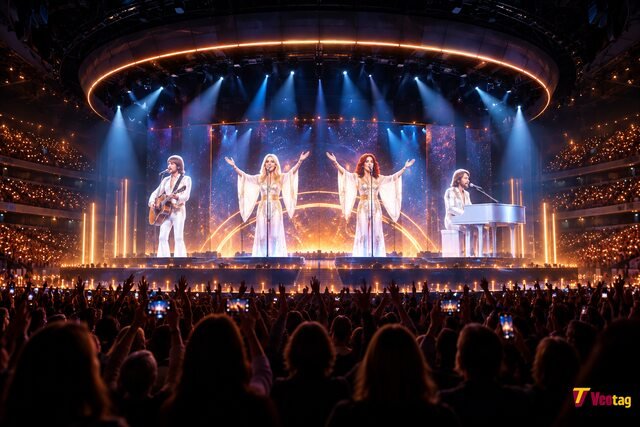
ABBA Voyage benefits enormously from having a venue designed around the production rather than squeezing its technology into an existing theatre.
The ABBA Arena is located at Pudding Mill Lane, London E15 2RU, within Queen Elizabeth Olympic Park. Pudding Mill Lane station is approximately a one-minute walk away, while Stratford is around a 25-minute walk, according to the venue’s current visitor information.
ABBA Voyage plan-your-visit information
The custom venue allows the production’s sound, sightlines and technical infrastructure to work as an integrated system. The official site lists bars, food concessions, merchandise outlets and accessible facilities within the arena.
One useful practical detail is easy to overlook: photography and video recording are prohibited during the actual concert. Photos are permitted outside the arena and within the concourse, but the production asks guests not to photograph or record the performance itself.
Who Will Enjoy ABBA Voyage Most?
ABBA fans are the obvious audience, but you do not need encyclopedic knowledge of the band to enjoy it.
The show works particularly well for people who already associate ABBA’s songs with parties, family memories, weddings, films or nights out. Familiarity makes the communal sections more powerful because a substantial part of the pleasure comes from sharing songs with the rest of the arena.
It can also appeal to people interested in theatre technology, digital production and the future of concerts. The show demonstrates a model that could influence how artists with extensive catalogues preserve or reinterpret live performances.
Someone who strongly believes a concert requires the featured artist to be physically present may be less convinced. That objection is perfectly reasonable because ABBA Voyage deliberately stretches the definition of “live.”
Tips Before You Go
A little planning can noticeably improve the evening.
Arrive with enough time to explore the venue rather than treating it like a cinema where slipping into your seat at the last moment makes little difference. Choose the Dance Floor if dancing is central to what you want from the night, or book a seat if comfort and a stable overview of the visuals matter more.
Use official ticket sellers. ABBA Voyage states that tickets should be purchased through its official providers and warns that tickets offered through unauthorised resale websites may be void.
Public transport is also the obvious option for many visitors. Pudding Mill Lane is immediately beside the venue, while Stratford provides broader transport connections. Check current Transport for London information before travelling because disruptions can change the easiest route.
Finally, resist watching too many detailed recordings or spoilers beforehand. Much of the show’s impact comes from discovering how the illusion works while sitting inside the arena.
ABBA Voyage Pros and Cons
The strongest reasons to go are the quality of the visual illusion, ABBA’s catalogue, the live musicians, the purpose-built arena and the communal atmosphere. It is more ambitious than a tribute show and more immersive than simply watching archival concert footage.
The limitations are equally straightforward. ABBA themselves are not physically performing, the central digital performance cannot offer true nightly spontaneity, and tickets can become considerably more expensive than the entry-level price depending on the date and location chosen.
There is also a philosophical question underneath the entertainment. Some people will find the possibility of digitally preserving performers fascinating. Others may prefer concerts in which ageing, mistakes and unpredictability remain part of the event.
ABBA Voyage makes a persuasive case for the former without making the latter obsolete.
Final Verdict: Is ABBA Voyage Worth It?
ABBA Voyage is worth seeing, especially if you already love ABBA. The songs would make an enjoyable night on their own, but the production turns them into something much harder to replicate elsewhere.
The most impressive part is not simply that youthful digital versions of Agnetha, Björn, Benny and Anni-Frid appear on stage. It is that lighting, live musicians, sound, staging and audience participation combine until the technology stops demanding your attention.
There are limitations. You are not attending a conventional ABBA reunion, and the digital performers cannot offer the unpredictability of four musicians physically sharing a stage.
But judging the production only by what it lacks misses what it achieves. ABBA Voyage creates a form of concert that could not exist conventionally and makes thousands of people respond to it as a shared live event.
For an ABBA fan visiting London, that makes it far more than a technological curiosity.
Read Also: Teddy Swims Scarborough: What Happened at His 2026 Open Air Theatre Shows
FAQ’s
The four members of ABBA are not physically performing at the ABBA Arena. Digital versions of the group form the centre of the production, while live musicians perform as part of the concert. The project was created with the involvement of all four ABBA members.
The Dance Floor is generally better for visitors who want to dance and experience a more energetic concert atmosphere. Seats are preferable if comfort and a consistent view of the complete visual production matter more.
Yes. The venue says dancing is permitted in seated areas, but guests should consider people around them who may be unable to stand.
Official concert tickets currently start from £40.50, with prices varying by ticket type and performance. Eligible visitors aged 16 to 25 can also find £35 Dance Floor tickets for selected performances. Prices and availability can change, so check the official ticket page before booking.
ABBA Voyage takes place at the purpose-built ABBA Arena in Queen Elizabeth Olympic Park, Pudding Mill Lane, London E15 2RU. Pudding Mill Lane is the closest station, approximately a one-minute walk from the arena.


