

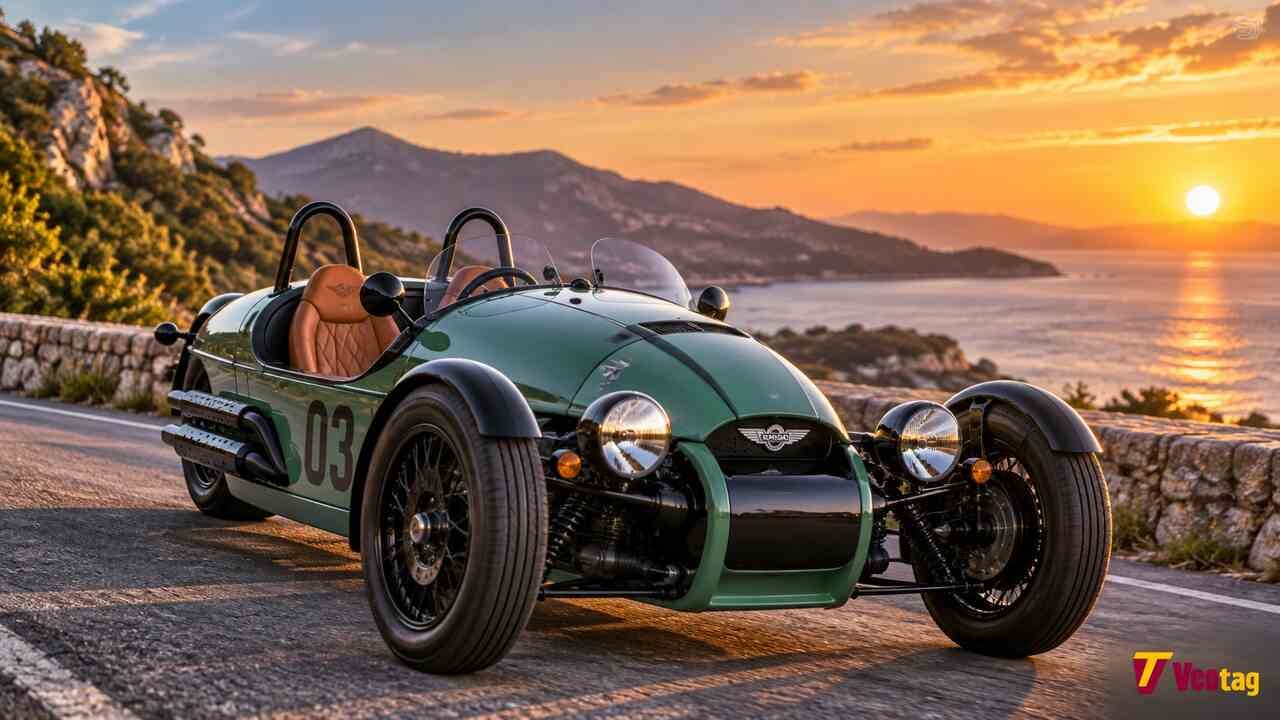
The Morgan Super 3 is a lightweight, three-wheeled sports vehicle designed to deliver an engaging, open-air driving experience rather than maximum speed or everyday practicality. It combines a 1.5-litre Ford three-cylinder engine, five-speed manual gearbox, aluminium construction, and distinctive styling with improved usability compared with the previous Morgan 3 Wheeler.
Morgan Super 3 Specifications at a Glance
The Super 3 uses a Ford Dragon naturally aspirated three-cylinder engine connected to a five-speed manual transmission. Morgan quotes 118 bhp, approximately 150 Nm of torque and a 0 to 62 mph time of around seven seconds. Its 130 mph claimed top speed is striking for a machine with three wheels, no roof and a cockpit that leaves its occupants almost completely exposed to their surroundings.
| Specification | Morgan Super 3 |
| Engine | Ford Dragon 1.5-litre naturally aspirated inline-three |
| Power | 118 bhp (88 kW) at 6,500 rpm |
| Torque | 150 Nm (111 lb-ft) at 4,500 rpm |
| Transmission | Five-speed manual |
| Drive | Single rear wheel |
| Dry weight | 635 kg |
| 0 to 62 mph | Approx. 7.0 seconds |
| Top speed | 130 mph (209 km/h) |
| Length | 3,581 mm |
| Width | 1,850 mm |
| Height | 1,132 mm |
| Wheelbase | 2,532 mm |
| Fuel capacity | Approx. 31.8 to 32 litres |
| UK starting price | £39,995 including VAT |
Morgan’s current UK model page lists the Super 3 from £39,995 including VAT. Actual transaction prices can be considerably higher once paint, luggage equipment, cockpit finishes and other personalization options are added.
What Makes the Morgan Super 3 Different?
Most modern performance cars attempt to increase capability through more power, more grip, automatic gearboxes and electronic driver assistance. The Super 3 takes almost the opposite approach. It uses relatively modest power in a very light vehicle and deliberately keeps several controls mechanically direct.
The steering is manual rather than power-assisted. Braking is hydraulic but operates without a servo or ABS according to Morgan’s technical specification. The front uses double-wishbone suspension with pullrod-actuated coilovers, while the rear uses a swingarm supporting the driven rear wheel.
That combination changes what “performance” means. A seven-second sprint to 62 mph would not make a conventional modern sports car particularly fast, but occupants of the Super 3 sit low behind small windscreens with the front wheels visible and the environment rushing past them. Speed therefore feels more dramatic than the acceleration figure suggests.
The Super 3 is better understood as an experience-focused sports vehicle than a conventional sports car judged primarily by lap times or horsepower.
The 1.5-Litre Ford Engine Delivers Modest Power in a Very Light Vehicle
Morgan uses Ford’s naturally aspirated Dragon three-cylinder engine rather than the exposed motorcycle-derived V-twin found in the previous Morgan 3 Wheeler.
The current owner’s handbook identifies the engine as a 1,497cc DOHC three-cylinder with an 11:1 compression ratio. Maximum power is 118 bhp at 6,500 rpm, while maximum torque is 150 Nm at 4,500 rpm.
Those figures appear modest until vehicle weight is considered.
Using Morgan’s quoted 635 kg dry weight and 118 bhp output gives a simple dry-weight power-to-weight calculation of roughly:
118 bhp ÷ 0.635 tonnes = approximately 186 bhp per tonne
Real running weight will be higher once fuel, occupants and luggage are added, so that calculation should not be interpreted as an operating-weight figure. It does, however, explain why the Super 3 does not need a large engine to produce an engaging driving experience.
The naturally aspirated configuration is also significant. Rather than relying on a turbocharger for a large surge of low-rev torque, the engine encourages the driver to use the gearbox and rev range, which suits the car’s intentionally mechanical character.
A Five-Speed Manual Is the Only Transmission
There is no automatic Morgan Super 3. Morgan offers the model exclusively with a manual gearbox.
The five-speed transmission is paired with a relatively short-throw gear change, while the pedal arrangement is designed to support heel-and-toe downshifts. Morgan deliberately emphasizes the connection between clutch, gearbox, steering and engine rather than isolating the driver from those processes.
That makes the Super 3 particularly appealing to drivers who enjoy operating a car rather than simply commanding it. It also creates an obvious limitation: anyone who needs or strongly prefers an automatic transmission will need to look elsewhere.
How Fast Is the Morgan Super 3?
Morgan quotes approximately 7.0 seconds from 0 to 62 mph and a 130 mph top speed.
Those figures only tell part of the story. The Super 3 has no conventional roof, large windscreen or insulated cabin. At road speeds that would feel ordinary in a modern coupe, its occupants experience significantly more wind, noise and movement.
The driver’s perception of acceleration is therefore very different from the experience in a heavier closed sports car.
A 130 mph maximum speed should also be viewed as technical capability rather than the central reason to own the vehicle. Its combination of exposure, manual steering and unusual three-wheel layout makes involvement at ordinary road speeds a much larger part of its appeal.
The Aluminium Monocoque Is a Major Change From the Previous 3 Wheeler
The Super 3 did not simply replace the engine of Morgan’s previous 3 Wheeler. It introduced fundamentally different construction.
Morgan describes the platform as an Aluminium Modular Monocoque. Structural aluminium castings at the front support the engine and suspension while contributing to airflow management. The side blades guide air through side-mounted radiators and double as mounting points for luggage and accessories.
The engineering shift allowed Morgan to retain the visual drama of a three-wheeler while packaging a conventional automotive engine inside the body.
It also explains one of the Super 3’s distinctive design features. The side structures are not merely decorative panels. They form part of the vehicle’s functional approach to cooling, customization and luggage carrying.
Morgan Super 3 vs Morgan 3 Wheeler
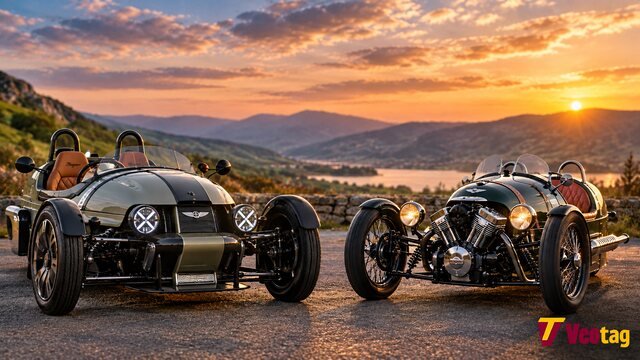
The Super 3 follows the Morgan 3 Wheeler that entered production in 2011 and finished production in 2021. Although both vehicles use two front wheels and one driven rear wheel, their engineering and personality differ substantially.
| Feature | Morgan Super 3 | Previous Morgan 3 Wheeler |
| Engine | Ford 1.5L inline-three | S&S 1,998cc V-twin |
| Power | 118 bhp | 82 bhp |
| Torque | 150 Nm | 140 Nm |
| Dry weight | 635 kg | 525 kg |
| 0 to 62 mph | Approx. 7.0 sec | 6.0 sec |
| Top speed | 130 mph | 115 mph |
| Engine position | Inside bodywork | Exposed at front |
| Transmission | Five-speed manual | Five-speed manual |
| Character | More modern and touring-oriented | More mechanically theatrical |
Morgan lists the older car at 82 bhp and 525 kg dry, compared with 118 bhp and 635 kg for the Super 3. Interestingly, the previous 3 Wheeler’s quoted 0 to 62 mph time was faster at six seconds despite producing less power.
The important distinction is not simply which version wins an acceleration test. The old 3 Wheeler made its exposed V-twin part of the visual and mechanical spectacle. The Super 3 sacrifices some of that vintage appearance in exchange for a more integrated drivetrain, improved packaging and a platform conceived specifically for this generation.
Buyers choosing between used examples of the older model and a Super 3 should therefore consider the kind of experience they want rather than comparing horsepower alone.
What Is the Morgan Super 3 Like to Drive?
The Super 3 is designed to make the driver aware of speed, road surface and mechanical inputs. Manual rack-and-pinion steering removes a layer of assistance between the front tyres and the driver’s hands, while the low seating position places the front wheels within the driver’s peripheral view.
The unusual layout also means driving it requires a slightly different mental model from driving a normal four-wheel car. There are two widely separated tracks at the front but only one tyre path at the rear. On broken roads, pothole placement matters because avoiding an obstacle with the front tyres does not automatically mean the rear tyre will miss it.
Its narrow front tyres are also unusual by modern performance-car standards. Morgan specifies 130/90 R20 front tyres and a wider 195/65 R15 rear tyre. The tall, narrow fronts contribute to the car’s distinctive appearance while supporting the steering characteristics Morgan wanted.
Drivers expecting the planted, highly assisted behaviour of a contemporary performance coupe may find the Super 3 strange. Drivers specifically seeking steering feel, mechanical interaction and a sense of occasion may consider that strangeness the entire point.
Is the Morgan Super 3 Practical?
Practicality is limited, but Morgan has put considerably more thought into luggage than the vehicle’s appearance initially suggests.
The Super 3 has under-seat storage and space within the rear body area, while optional equipment includes rear and side luggage racks, panniers and hard-shell cases. Its side blades were designed to accommodate mounting solutions rather than forcing owners to improvise their own luggage systems.
There are still obvious compromises. It is a two-seater without a conventional enclosed cabin, substantial built-in luggage compartment or the weather protection expected from an ordinary road car.
A weekend trip therefore requires a different packing strategy. Soft bags and purpose-designed cases are more sensible than conventional suitcases, and passengers need to accept that travelling light is part of the experience.
For someone buying a Super 3 as a third or recreational vehicle, those compromises may be minor. For someone trying to make it their only car, they become far more important.
Weather Protection Requires Realistic Expectations
The Super 3 has an intentionally exposed cockpit. Small wind deflectors provide some airflow management, but there is no conventional roof enclosing the occupants.
Morgan designed the cockpit components with exposure in mind and describes the interior as resistant to water and dust, helping the vehicle tolerate conditions that would be problematic for an ordinary exposed interior.
Weather resistance should not be confused with weather isolation, however. Driving through rain in a Super 3 is fundamentally different from sitting inside a sealed convertible with its roof raised.
Owners planning longer journeys should consider waterproof clothing, suitable luggage and changing temperatures as part of trip preparation. That is not necessarily a design flaw. It is an unavoidable consequence of choosing a vehicle whose appeal depends heavily on removing barriers between the occupants and the environment.
Morgan Super 3 Fuel Economy and Driving Range
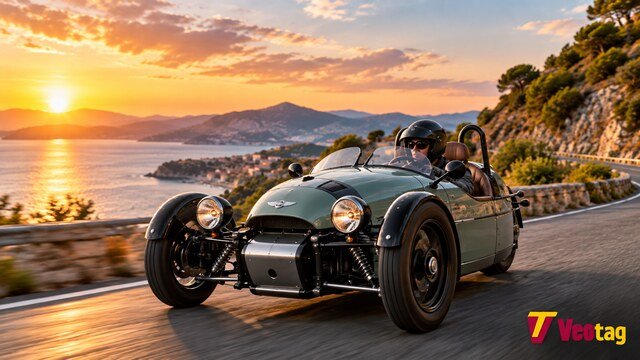
Morgan currently publishes combined consumption of about 40 mpg and 7.0 litres per 100 km on its model page. Its technical documentation lists a fuel tank of roughly 32 litres.
A theoretical calculation using 7.0 L/100 km and a 31.8-litre tank gives:
31.8 ÷ 7.0 × 100 = approximately 454 km, or about 282 miles.
That is only a mathematical estimate. Real range varies with driving style, road conditions, fuel reserve, passenger load and other factors, so owners should not assume the full theoretical figure is routinely usable.
The calculation nevertheless shows that the Super 3 can offer meaningful touring range despite its tiny footprint.
Size and Road Presence
The Super 3 is just 3,581 mm long, making it short by modern-car standards, but its 1,850 mm overall width means it is not especially narrow. The wide front track is visually responsible for much of the vehicle’s stance.
Its overall height is only 1,132 mm, creating the impression that occupants sit almost on the road rather than inside a conventional vehicle.
One practical number worth noticing is its 100 mm ground clearance. Drivers entering steep driveways, crossing sharp ramps or travelling on poor surfaces need to remain conscious of clearance beneath the vehicle.
Morgan also lists a 12.4-metre turning circle, which is larger than someone might expect from such a short vehicle. Tight parking manoeuvres therefore may not be as effortless as the Super 3’s compact length suggests.
How Much Does a Morgan Super 3 Cost?
Morgan currently lists the UK starting price at £39,995 including VAT.
That figure represents the starting point rather than the cost of every Super 3 leaving the factory. Morgan offers extensive customization, and dealer inventory illustrates how significantly specification can affect pricing. Morgan’s own dealer search currently includes new 2026 cars listed above the base UK price, depending on equipment and configuration.
Buyers should therefore compare quotations by specification rather than assuming that two Super 3s with the same model year are financially equivalent.
A particularly heavily optioned car may include upgraded paint, alternative cockpit finishes, wind deflectors, luggage systems, wheel treatments and appearance packages.
For that reason, the useful purchasing question is not simply “How much is a Morgan Super 3?” but “What equipment is included in the quoted price?”
Is the Morgan Super 3 a Car or Motorcycle?
Its legal classification depends on the market.
Morgan states that the Super 3 is registered as a motorised tricycle in the UK and Europe, while in the United States it is federally classified as a motorcycle.
That distinction matters because licensing, helmet requirements, insurance, registration rules and other obligations can differ by jurisdiction.
A US buyer should therefore check the rules in their individual state rather than assuming the federal motorcycle classification determines every local requirement. Similarly, buyers elsewhere should verify the regulations that apply where the vehicle will actually be registered and driven.
Safety and Driver-Assistance Expectations Are Different From a Modern Car
Anyone considering a Super 3 should understand that its design philosophy differs substantially from that of a conventional passenger car.
Morgan’s technical specification states that the braking system operates without ABS or servo assistance. Steering is also manually assisted rather than power-assisted.
This creates greater mechanical involvement but also means buyers should not expect the same collection of electronic intervention systems found on most modern cars.
The open cockpit creates another obvious difference. Occupants do not have a conventional roof, side structure and enclosed passenger compartment surrounding them in the way they would in a modern coupe or saloon.
Prospective owners should assess these characteristics as part of the vehicle’s overall design rather than looking only at performance and styling.
Who Is the Morgan Super 3 Best Suited To?
The Super 3 makes the most sense for a buyer who sees driving itself as recreation.
A sports-car owner seeking the fastest acceleration for the money will find dramatically quicker options. A commuter prioritizing comfort, storage and weather protection can find vastly more practical vehicles. Someone seeking driver-assistance technology will also find more suitable choices elsewhere.
The Super 3 becomes compelling when the purchasing priorities are reversed. It provides a manual gearbox, very low seating position, open-air exposure, unusual steering feel, lightweight construction and styling that makes almost every journey an event.
That also explains why comparing it solely with cars costing around £40,000 can be misleading. Its value proposition depends less on objective transportation capability and more on how unusual its driving experience is.
What Should You Check Before Buying One?
A prospective buyer should spend meaningful time in the Super 3 before ordering rather than relying only on its appearance. The cockpit dimensions, pedal position, steering effort and constant exposure are integral parts of the ownership experience.
A test drive should also include ordinary roads rather than only smooth, fast routes. Low-speed manoeuvring, visibility, traffic, rough surfaces and getting in and out of the cockpit can reveal more about long-term compatibility than a short blast on an open road.
When comparing new, demonstrator and used examples, examine specification carefully. Optional luggage systems and wind deflectors may have much more practical value to one owner than expensive cosmetic finishes.
Finally, check local registration, insurance and licensing requirements before completing the purchase, particularly in markets where three-wheel vehicles occupy a different legal category from normal passenger cars.
Morgan Super 3 Advantages and Limitations
The Super 3’s strengths and weaknesses are unusually closely related. Removing insulation, assistance and bodywork increases involvement, but the same choices reduce comfort and practicality.
| Strength | Corresponding limitation |
| Extremely distinctive driving experience | Less comfortable than a normal sports car |
| 635 kg dry weight | Very little physical separation from the environment |
| Manual gearbox and steering | Greater driver effort |
| Open cockpit | Limited weather protection |
| Highly customizable | Options can substantially raise the final price |
| Compact overall length | 1,850 mm width and 12.4 m turning circle still require consideration |
| Touring luggage accessories available | Storage remains limited compared with a conventional car |
| 118 bhp is enough for entertaining performance | Not objectively fast by current sports-car standards |
This is why conventional specifications alone do not determine whether the Super 3 is a good purchase. For the right owner, the disadvantages are part of the attraction. For the wrong owner, they can become frustrating quickly.
Is the Morgan Super 3 Worth Buying?
The Morgan Super 3 is worth considering if you specifically want the experience it provides rather than simply a sports car at its price point.
A buyer approaching it with conventional measures such as horsepower, 0 to 60 times, luggage volume and cabin refinement may struggle to justify the cost. Many ordinary sports cars offer greater speed, comfort and practicality.
But conventional alternatives do not replicate the Super 3’s combination of three-wheel architecture, open cockpit, manual steering, low mass and visual theatre. That scarcity is central to its value.
The strongest case for buying one therefore comes from emotional and experiential differentiation, not specification-sheet dominance.
A sensible decision framework is simple: if you need the Super 3 to behave like an ordinary car, it probably is not the right choice. If you already have practical transportation covered and want something that makes modest speeds feel memorable, its unusual compromises begin to make considerably more sense.
Conclusion
The Morgan Super 3 succeeds by doing something increasingly rare: it makes the physical act of driving more important than outright performance. Its 118 bhp Ford engine, five-speed manual gearbox and 635 kg dry weight are only part of the equation. Manual steering, an open cockpit, exposed front wheels and a single driven rear wheel create an experience that conventional sports cars cannot easily reproduce.
At a UK starting price of £39,995, it is not a rational choice for anyone seeking maximum speed or practicality per pound. That is also why direct comparisons can miss the point. The Super 3 is aimed at buyers willing to exchange weather protection, storage and electronic assistance for involvement and individuality.
For those buyers, the question is less whether the Morgan Super 3 is the most capable vehicle for the money and more whether any conventional four-wheeled alternative can provide quite the same experience.
Read Also: Comfort and Elegance: The Best Full-Size Sedan for Comfort and Style
FAQ’s
The Super 3 uses a naturally aspirated Ford Dragon 1.5-litre three-cylinder petrol engine. Morgan lists output at 118 bhp and 150 Nm of torque.
Morgan quotes a 0 to 62 mph time of approximately seven seconds and a maximum speed of 130 mph, or 209 km/h.
Morgan currently advertises the Super 3 from £39,995 including VAT in the UK. Options, accessories and dealer-specific configurations can raise the final price considerably.
It does not have a conventional enclosed roof. The Super 3 uses an exposed two-seat cockpit with small wind deflectors, so owners should expect significantly less weather protection than in a conventional convertible.
Morgan’s published technical specification describes its hydraulic braking system as operating without ABS or servo assistance.
Yes, provided the occupants accept its compromises. Morgan offers side and rear luggage solutions, panniers and hard cases specifically to support touring. Long journeys still involve considerably more exposure to wind, weather and noise than travelling in a conventional car.
