






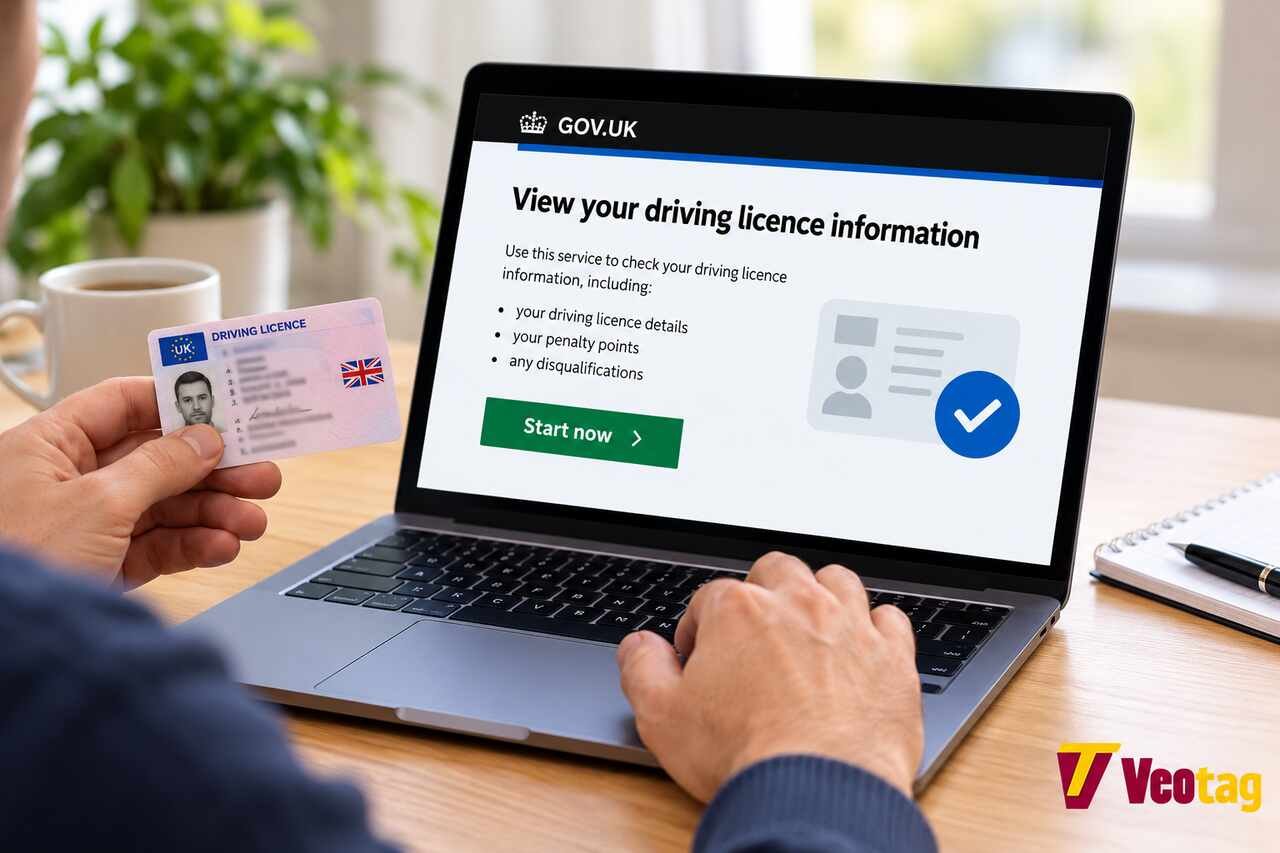
You can check your driving licence points online for free using the official DVLA service on GOV.UK. Drivers in England, Scotland, and Wales can view their penalty points, driving endorsements, disqualifications, and licence details by entering their driving licence number, National Insurance number, and registered postcode.
How to Check Driving Licence Points Online
The easiest way to check your driving licence points is through the official DVLA service on GOV.UK. You can access your driving record at any time without paying a fee.
Step 1: Visit the Official GOV.UK Website
Open the official service:
**https://www.gov.uk/view-driving-licence**
Select the option to start the service. Make sure you are using the genuine GOV.UK website rather than an unofficial service that may charge for information available free of charge.
Step 2: Enter Your Personal Details
You will normally need three pieces of information:
- Driving licence number: The unique number printed on your photocard driving licence.
- National Insurance number: Your personal identification number used for tax and National Insurance purposes.
- Postcode: The postcode associated with your driving licence record.
Enter the details exactly as registered with the DVLA. Incorrect or outdated information may prevent the system from identifying your record.
Step 3: View Your Driving Licence Record
After your details have been verified, you can view information held on your driving licence record, including:
- Current penalty points and driving endorsements
- Details of recorded driving offences
- Driving disqualifications, where applicable
- Categories of vehicles you are permitted to drive
- Other relevant driving licence information
Check the endorsement details carefully, especially the offence code, number of penalty points, and relevant dates.
Step 4: Save or Share Your Driving Licence Information
If an employer or vehicle hire company needs to check your driving record, you can generate a driving licence check code through the official service.
The check code is valid for 21 days and can be used once. It allows an authorised person to view relevant driving licence information when combined with the required personal details.
A check code is different from your driving licence number. You should share it only with a legitimate organisation that needs to verify your driving entitlement.
What Are Driving Licence Penalty Points?
Driving licence penalty points are recorded against a driver’s licence following certain motoring offences. They are also known as endorsements.
The number of points depends on the offence and the circumstances. More serious offences can attract higher penalties, disqualification, or other legal consequences.
For example, speeding can result in penalty points, while dangerous driving may lead to a driving ban and a more serious endorsement.
Common Driving Offences and Penalty Points
| Driving offence | Typical penalty points |
| Speeding | 3 to 6 |
| Using a handheld mobile phone while driving | 6 |
| Driving without insurance | 6 to 8 |
| Running a red traffic light | Usually 3 |
| Careless driving | 3 to 9 |
| Dangerous driving | 3 to 11, with obligatory disqualification |
| Driving without a valid MOT certificate | Normally a fine, not penalty points |
These are general ranges or standard penalties. The exact outcome depends on the offence, legal proceedings, and any applicable disqualification.
Not every motoring offence results in points. Some offences carry fines, driving bans, or other penalties instead.
How Many Points Can You Have Before Losing Your Licence?
Drivers who accumulate 12 or more penalty points within three years can face disqualification under the UK’s totting-up rules.
However, the rules differ for newly qualified drivers.
Experienced Drivers
For most drivers, accumulating 12 or more qualifying points within three years normally results in a driving disqualification.
The usual minimum disqualification periods are:
| Circumstances | Normal minimum disqualification |
| 12 or more qualifying points within three years | 6 months |
| Second relevant disqualification within three years | 12 months |
| Third relevant disqualification within three years | 2 years |
A court may impose a shorter ban or decide not to disqualify in exceptional circumstances, but this is not automatic.
The three-year period generally relates to the dates the offences were committed, not simply the dates when points appeared on your online record.
New Drivers
Drivers who passed their first driving test less than two years ago face stricter rules.
Under the Road Traffic (New Drivers) Act 1995, accumulating six or more qualifying penalty points during the two-year probationary period normally results in licence revocation.
For example, a newly qualified driver who receives three points for speeding and another three points for a later offence may have their licence revoked.
If this happens, the driver must apply for a provisional licence and pass both the theory and practical driving tests again to regain a full licence.
Points received before passing the first driving test can also count towards the six-point threshold if they remain valid during the probationary period.
How Long Do Driving Licence Points Stay on Your Record?
Penalty points do not all remain on a driving licence record for the same length of time.
Most endorsements stay on the record for four years, while certain serious offences remain recorded for 11 years.
An important distinction is that the period during which points count towards disqualification can be shorter than the period the endorsement remains visible on your record.
Penalty Point Validity and Endorsement Duration
| Offence category | How long points generally count | How long endorsement stays on record |
| Most speeding offences | 3 years | 4 years |
| Most traffic light offences | 3 years | 4 years |
| Using a handheld mobile phone | 3 years | 4 years |
| Driving without insurance | 3 years | 4 years |
| Certain drink-driving and drug-driving offences | Special rules apply | 11 years |
| Certain offences causing death | Depends on the offence | 4 or 11 years |
For many offences, the endorsement period starts from the date of the offence. For some serious offences, it starts from the date of conviction.
The precise offence code determines which rule applies.
Do Points Disappear Automatically?
Yes. Endorsements are generally removed automatically when their applicable record-retention period ends.
You do not normally need to submit an application or pay a fee to have an expired endorsement removed.
However, an endorsement may still appear on your record after its points have stopped counting towards a totting-up disqualification.
For example, three speeding points may count for three years but remain on your driving record for four years.
That distinction matters when checking your points for insurance, employment, or licence-related purposes.
How to Check Driving Licence Points Without Going Online
If you cannot access the DVLA online service, you can contact the DVLA directly for help checking your driving licence information.
This may be useful if you have forgotten your National Insurance number, cannot access the online system, or need assistance with your driving record.
Contact the DVLA
You can contact the DVLA through its official contact services and ask how to obtain your driving licence information.
You may need to verify your identity before your record can be discussed or released.
If you need a written record, ask about the available postal options. Postal requests generally take longer than checking online.
You should not use an unofficial website that promises to remove penalty points or obtain confidential licence information for a fee.
How to Read Penalty Points and Endorsement Codes
When you check your driving licence points, you may notice a combination of letters and numbers next to an offence.
These are endorsement codes. They identify the type of motoring offence recorded against your licence.
Understanding the code can help you establish why points were added and how long the endorsement will remain on your record.
Common DVLA Endorsement Codes
| Endorsement code | Meaning | Penalty points |
| SP30 | Exceeding the statutory speed limit on a public road | 3 to 6 |
| SP50 | Exceeding the speed limit on a motorway | 3 to 6 |
| CU80 | Breach of vehicle-control requirements, including mobile phone use | 3 to 6 |
| IN10 | Using a vehicle without required third-party insurance | 6 to 8 |
| TS10 | Failing to comply with traffic light signals | 3 |
| CD10 | Driving without due care and attention | 3 to 9 |
| MS90 | Failing to provide information about the driver’s identity | 6 |
| TT99 | Disqualification under the totting-up rules | Not a separate points award |
For example, if your record shows SP30 with three penalty points, it indicates a speeding endorsement relating to a statutory speed limit on a public road.
If your record shows IN10 with six points, it indicates an endorsement for using a vehicle without the required insurance.
Some codes cover offences for which disqualification is obligatory or possible. The points range alone does not describe every potential penalty.
What to Do If Your Driving Licence Points Are Incorrect

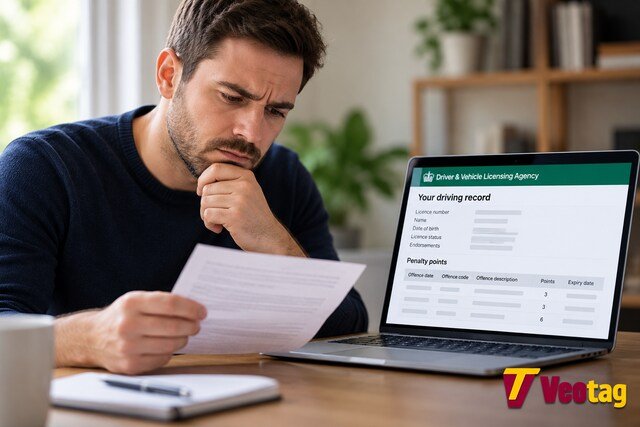
If your DVLA driving record shows incorrect penalty points, you should investigate the discrepancy rather than assume it will resolve itself.
Mistakes may involve an incorrect offence date, an inaccurate endorsement, or information that does not match the relevant court decision.
Check the Endorsement Details
Start by reviewing the offence code, penalty points, and dates displayed on your record.
Compare the information with any fixed penalty notice, court correspondence, or other official documents you received.
Remember that the offence date and conviction date may be different. This does not necessarily mean the record is incorrect.
Contact the Relevant Court
If the endorsement details resulting from a conviction are incorrect, contact the court that dealt with the offence.
The DVLA records endorsements but does not generally have authority to overturn a court’s decision.
If the problem concerns your personal details or access to the online service, contact the DVLA for assistance.
Keep Supporting Documents
Retain copies of relevant documents, including penalty notices, court correspondence, and any written confirmation of a correction.
These records may be useful if you need to explain a discrepancy to an insurer or employer.
An incorrect entry should not be treated as removed until the relevant authority confirms the correction.
Can You Check Someone Else’s Driving Licence Points?
You can check another person’s driving licence information if they give you the necessary permission and details.
Employers, fleet managers, and car hire companies may need to verify whether a driver holds the appropriate licence and has relevant endorsements or disqualifications.
The driver can generate a check code through the official DVLA service.
To use the checking service, the organisation normally needs the driver’s check code and the last eight characters of their driving licence number.
The code is valid for 21 days and can be used once.
You must not attempt to access another person’s confidential driving licence information without their permission.
Do Driving Licence Points Affect Car Insurance?
Penalty points can affect car insurance premiums because insurers use driving history when assessing risk.
The effect depends on the offence, the number of endorsements, your driving history, the insurer’s underwriting criteria, and other circumstances.
For example, a driver with three speeding points may receive a different premium from a driver with six points for driving without insurance.
However, there is no universal percentage increase that applies to every driver.
When Should You Tell Your Insurer About Penalty Points?
You must answer questions about convictions and endorsements accurately when applying for insurance or renewing a policy.
Whether you must report new penalty points immediately during an existing policy depends on your insurer’s terms and any applicable disclosure requirements.
Some insurers require notification when an endorsement occurs, while others ask for updated information at renewal.
Check your policy wording or contact your insurer rather than assuming that you can wait until renewal.
Can Expired Points Still Affect Insurance?
Potentially, yes.
An endorsement may stop counting towards a driving disqualification before it disappears from your DVLA record. Insurers may also ask about convictions over a specified period.
You should answer the exact questions asked by the insurer, including the relevant dates and offence details.
Do not assume that points becoming inactive means the underlying conviction no longer needs to be disclosed.
Can You Remove Driving Licence Points Early?
You generally cannot pay the DVLA to remove valid penalty points early.
Endorsements remain on your driving record for the legally prescribed period unless they are corrected or removed through an appropriate legal process.
A driving awareness course may sometimes be offered as an alternative to penalty points for an eligible offence, such as certain speeding offences.
However, eligibility depends on the circumstances, and the police decide whether to offer a course.
Completing a course does not automatically remove points that have already been lawfully imposed.
If you believe a conviction or endorsement is legally incorrect, obtain appropriate legal advice about the available options.
Common Problems When Checking Driving Licence Points
Although the DVLA online service is straightforward, some drivers experience difficulties accessing their records.
| Problem | Possible reason | What to do |
| Driving licence number not recognised | Incorrectly entered number | Check the characters against your licence |
| Postcode not accepted | Address details do not match the DVLA record | Verify your registered postcode |
| National Insurance number unavailable | Number forgotten or misplaced | Retrieve it through the appropriate government service |
| Expected points not displayed | Endorsement not yet recorded or another record issue | Check the paperwork and contact the relevant authority |
| Expired points still visible | Endorsement retention period has not ended | Check the offence code and applicable dates |
| Employer cannot access record | Check code expired or already used | Generate a new check code |
One common source of confusion is assuming that a fine automatically results in penalty points.
Some motoring offences result in a financial penalty without an endorsement. Others may result in a driving disqualification.
If you recently received a penalty notice, read it carefully to establish whether penalty points apply and what action is required.
Conclusion
The simplest way to check driving licence points is through the free DVLA service on GOV.UK. With your driving licence number, National Insurance number, and registered postcode, you can view your endorsements, check relevant dates, and identify any recorded driving disqualifications.
Remember that penalty points and endorsements do not necessarily expire at the same time. Most endorsements remain on a driving record for four years, while certain serious offences remain for 11 years.
Checking your record regularly, particularly after receiving a motoring penalty or before an insurance renewal, can help you understand your driving status and address any discrepancies promptly.
Read Also: Mazda CX-80: Engines, Interior, Space, Performance and Buying Guide
FAQ’s
Yes. You can check your driving licence points free of charge through the official GOV.UK driving licence service. You normally need your driving licence number, National Insurance number, and registered postcode.
The standard online DVLA service normally requires additional information, including your National Insurance number and postcode. Your driving licence number alone is not sufficient for the usual online check.
There is no single guaranteed timeframe. Points are recorded after the relevant fixed penalty or court process, and administrative processing can take time. If an expected endorsement is missing, check your official paperwork or contact the relevant authority.
Yes, but Northern Ireland has a separate licensing system administered by the Driver & Vehicle Agency (DVA). The standard DVLA online service described here is for licences issued in England, Scotland, and Wales. Drivers in Northern Ireland should use the appropriate nidirect or DVA service.
For most four-year endorsements, penalty points count towards totting-up disqualification for three years, but the endorsement stays on the driving record for four years. Certain serious offences have longer periods. Points do not all disappear automatically after three years.
In many circumstances, yes. Six penalty points do not automatically disqualify an experienced driver. However, newly qualified drivers who reach six or more qualifying points within two years of passing their first driving test normally have their licence revoked. A court can also impose disqualification for certain offences regardless of the total points.


