

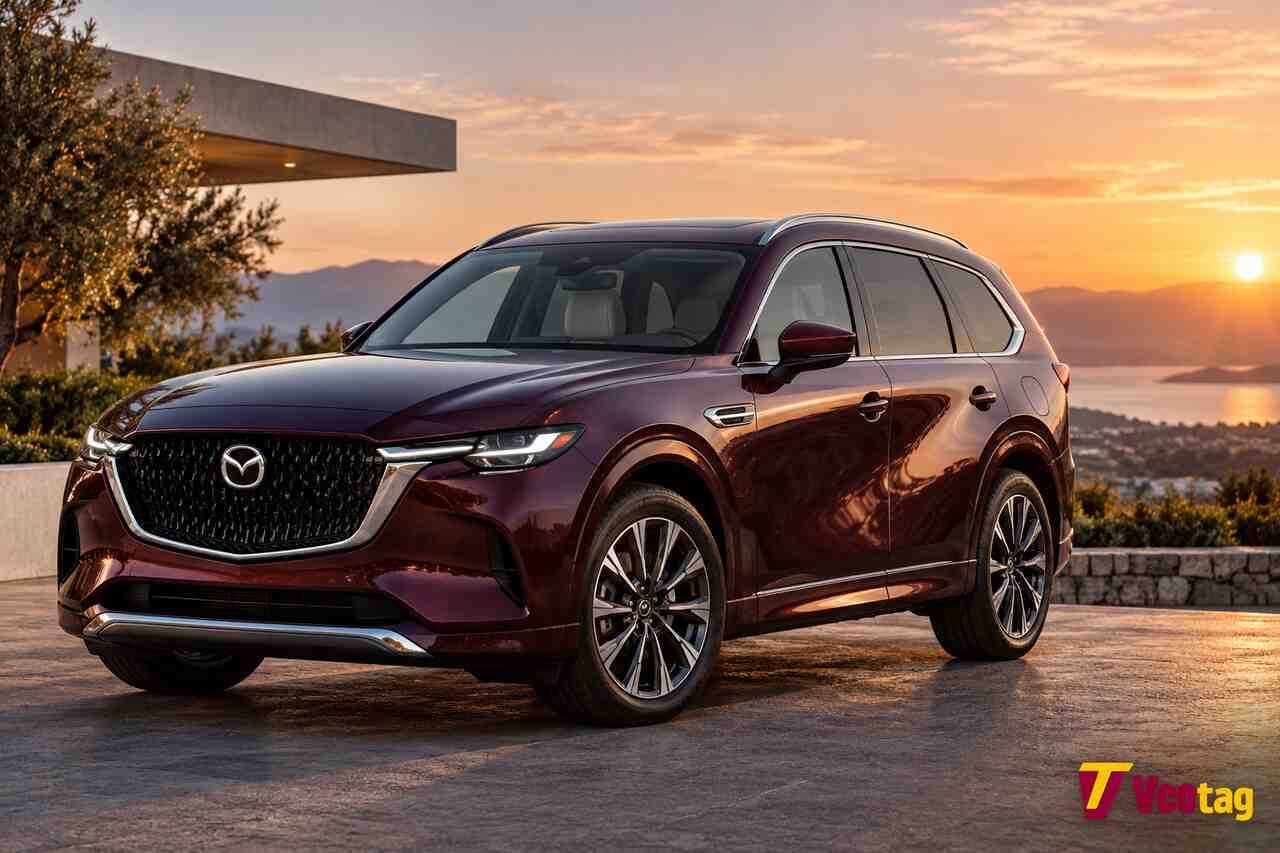
Mazda CX-80 as a large, premium-oriented three-row SUV built for families needing more space than the CX-60. It offers six- or seven-seat configurations, all-wheel drive, and a choice between a plug-in hybrid petrol engine and a 3.3-litre six-cylinder diesel mild hybrid.
Mazda CX-80 Specifications at a Glance
The following figures provide a useful overview of the European-market CX-80. Exact figures can vary slightly by market, trim and homologation specification.
| Specification | Mazda CX-80 PHEV | Mazda CX-80 3.3 Diesel |
| Engine | 2.5-litre petrol + electric motor | 3.3-litre six-cylinder diesel |
| Electrification | Plug-in hybrid | 48V mild hybrid |
| Maximum power | 327 PS | 254 PS |
| Maximum torque | 500 Nm | 550 Nm |
| Transmission | 8-speed automatic | 8-speed automatic |
| Drivetrain | AWD | AWD |
| 0-100 km/h | 6.8 seconds | 8.4 seconds |
| Top speed | 195 km/h | 219 km/h |
| Length | 4,995 mm | 4,995 mm |
| Wheelbase | 3,120 mm | 3,120 mm |
| Braked towing capacity | 2,500 kg | 2,500 kg |
| Seats | Up to 7 | Up to 7 |
The PHEV is substantially quicker from a standstill, while the diesel produces more peak torque and is particularly relevant to drivers covering long distances without regular access to charging.
How Big Is the Mazda CX-80?
The Mazda CX-80 measures approximately 4,995 mm long, making it a genuinely large SUV rather than a slightly stretched five-seater. Mazda lists a width of 2,142 mm and height of 1,712 mm in its Irish specifications, with a particularly long 3,120 mm wheelbase.
That wheelbase matters because the CX-80 needs to accommodate three rows without sacrificing all of its luggage space. It also means buyers moving from a compact or medium SUV should consider parking dimensions, garage space and manoeuvrability rather than looking only at passenger capacity.
The CX-80 is closely related to the CX-60 conceptually, but the extra seating changes its purpose. Mazda currently describes the CX-60 as a five-passenger large SUV and the CX-80 as carrying up to seven passengers.
Six Seats or Seven: Understanding the CX-80 Interior
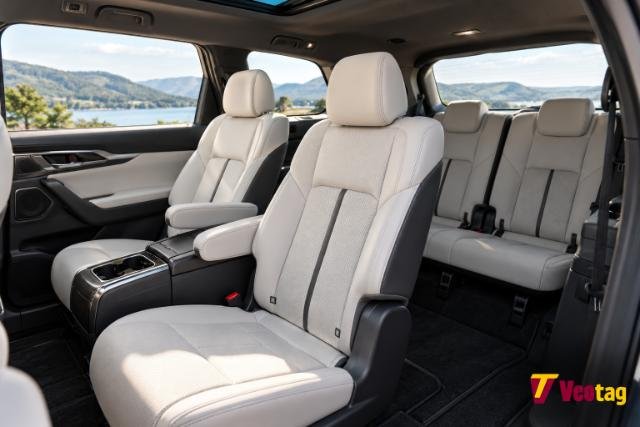
A major attraction of the CX-80 is the flexibility of its second and third rows.
The conventional configuration uses a three-person second-row bench and a two-person third row, creating seating for seven. Depending on trim and market, Mazda also offers second-row captain’s chairs. UK specifications, for example, list two captain’s chairs with a walkthrough on certain versions, while another arrangement combines ventilated captain’s chairs with a centre console.
The right configuration therefore depends on how the vehicle will be used.
A seven-seat version makes more sense when maximum passenger capacity matters. A six-seat captain’s-chair layout sacrifices one seating position but can give second-row occupants more individual space and make the cabin feel more luxurious.
Families should also consider who will use the third row. Occasional third-row use and daily transport for six or seven people impose different requirements, so sitting in every row before purchasing is more useful than judging the CX-80 solely from its exterior dimensions.
How Much Boot Space Does the Mazda CX-80 Have?
Cargo capacity changes considerably according to the seating arrangement.
Mazda’s published VDA measurements give the CX-80 258 litres with all three rows raised. Folding the third row increases luggage capacity to between 566 and 687 litres, depending on the position of the sliding second row. With both rear rows folded, Mazda quotes 1,221 litres measured to the seatback or up to 1,971 litres when the available space is measured to the ceiling.
| Seating arrangement | Approximate luggage capacity |
| Three rows in use | 258 litres |
| Third row folded | 566-687 litres |
| Second and third rows folded, to seatback | 1,221 litres |
| Second and third rows folded, to ceiling | Up to 1,971 litres |
This distinction is important for families. The CX-80 has considerable cargo capacity when functioning as a five-seater, but luggage room is naturally much tighter when all seven seats are occupied.
For a family holiday, for example, folding the third row transforms the vehicle into a much more accommodating luggage carrier. A family regularly travelling with seven occupants may instead need to consider a roof box or carefully assess whether 258 litres is sufficient for its normal load.
Mazda CX-80 Plug-in Hybrid
The CX-80 PHEV combines a 2.5-litre four-cylinder petrol engine, 129 kW electric motor and 17.8 kWh lithium-ion battery. Total system output is 327 PS, with maximum torque of 500 Nm. Mazda quotes 0-100 km/h in 6.8 seconds.
Mazda UK currently quotes an electric driving range of up to 38 miles for the CX-80 PHEV. Actual electric range depends on factors including temperature, driving style, speed, passenger/load weight and use of climate-control systems.
That makes the PHEV most compelling when it can be charged frequently. Someone whose everyday journeys fit within the available electric range may complete a substantial proportion of local driving without using the petrol engine.
The calculation changes if the vehicle is rarely plugged in. A PHEV carries its combustion engine, electric motor and relatively large battery simultaneously. Buyers who mainly drive long motorway distances and have limited charging opportunities should therefore compare the PHEV with the diesel rather than assuming the plug-in version will automatically use less fuel.
Mazda CX-80 3.3-Litre Diesel
The alternative European powertrain is unusual in an era of downsized four-cylinder engines: a 3.3-litre inline-six e-Skyactiv D diesel supported by a 48-volt mild-hybrid system.
In the specification cited here, it produces 254 PS and 550 Nm, drives all four wheels through an eight-speed automatic transmission, accelerates from 0-100 km/h in 8.4 seconds and reaches a quoted maximum speed of 219 km/h.
Its strengths are different from those of the PHEV. Drivers doing substantial motorway mileage do not need to manage charging stops or regularly recharge at home to obtain the intended benefit of the powertrain.
That does not automatically make diesel the better choice. Local taxation, fuel prices, emissions rules and driving patterns can materially alter ownership costs. The relevant question is how the vehicle will actually be used.
PHEV or Diesel: Which CX-80 Powertrain Fits Which Use?
The two powertrains address noticeably different driving patterns.
| Driving situation | PHEV considerations | Diesel considerations |
| Short daily journeys | Can make extensive use of electric mode if charged | Diesel’s long-distance strengths are less relevant |
| Home charging available | Strong practical advantage | Not required |
| Frequent long motorway journeys | Petrol engine becomes increasingly important once usable battery charge falls | Well suited to sustained long-distance use |
| Maximum acceleration | 0-100 km/h in 6.8 sec | 0-100 km/h in 8.4 sec |
| Towing | Up to 2,500 kg braked | Up to 2,500 kg braked |
| Regular charging unavailable | Reduces the reason for choosing a PHEV | Simpler usage pattern |
A useful way to choose is to examine a normal week rather than concentrating on official fuel-consumption figures.
For example, a driver travelling 25 miles each weekday with overnight charging has a very different use case from somebody driving 500 motorway miles every week. The first can potentially exploit the PHEV’s electric capability regularly. The second may place greater value on the diesel’s range and long-distance characteristics.
Towing Capacity Makes the CX-80 More Than a Family SUV
Mazda specifies a 2,500 kg braked towing capacity for both the PHEV and 3.3-litre diesel versions covered by its published specifications. Unbraked trailer capacity is listed at 750 kg.
That makes the CX-80 relevant to caravan, trailer and leisure users as well as large families.
Mazda’s Mi-Drive system can also provide different driving modes according to conditions. On the PHEV, Mazda describes Normal, Sport, Off-Road, Towing and EV modes.
A vehicle’s maximum towing figure should not be treated as the only towing consideration. Trailer limits, gross vehicle weight, payload, nose weight, licence requirements and local regulations can all affect what can legally and safely be towed.
Cabin Technology and Comfort
The CX-80’s interior positioning is more premium-oriented than its family-SUV dimensions alone might suggest.
Equipment varies by trim, but available UK specifications include heated seats, front-seat ventilation on certain grades, heated outer second-row seats, a heated steering wheel and powered seat adjustment. Higher specifications can also add captain’s chairs and additional comfort equipment.
The long cabin is particularly useful because the second row can slide and recline. Moving that row allows occupants to balance second-row legroom, third-row passenger space and cargo capacity according to the journey.
PHEV versions can also be equipped with a 1,500 W AC power outlet in the rear, depending on specification. Mazda highlights potential uses such as powering portable equipment while travelling.
As with most modern vehicles, equipment differences between trim levels can be significant. Buyers should compare the actual specification sheet for the vehicle being ordered instead of assuming every feature advertised for the CX-80 is standard.
Mazda CX-80 Safety
The CX-80 achieved a five-star Euro NCAP safety rating in 2024. Euro NCAP recorded scores of 92% for adult occupant protection, 88% for child occupant protection, 84% for vulnerable road-user protection and 79% for Safety Assist. The tested vehicle was the 2.5 PHEV, and Euro NCAP states that the rating also applies to listed 3.3-litre diesel variants.
Euro NCAP subsequently named the CX-80 its 2024 Best in Class Large SUV.
Its safety technology includes autonomous emergency braking, lane-support functions, speed assistance and direct driver-status monitoring. Euro NCAP reported good AEB performance against other vehicles in most of its tested scenarios.
There is a useful distinction between crash safety and assisted driving, however. In Euro NCAP’s separate 2025 assisted-driving assessment, Mazda’s Cruising & Traffic Support system received a “Good” grading. Euro NCAP praised several aspects of its operation while also identifying limitations in areas such as hands-on monitoring.
Driver-assistance systems remain assistance systems rather than substitutes for an attentive driver.
What to Check Before Buying a Mazda CX-80
The CX-80’s specification makes it attractive on paper, but several practical checks can determine whether it works for a particular household.
First, test the third row with the people who will actually use it. Then load the type of pushchair, suitcases or sports equipment normally carried. If considering captain’s chairs, compare their accessibility and comfort with the additional passenger capacity of the seven-seat bench configuration.
PHEV buyers should also establish where the vehicle will be charged. Access to reliable home or workplace charging can fundamentally change the ownership experience. Without regular charging, much of the reason for carrying a 17.8 kWh plug-in battery disappears.
Finally, remember the CX-80 is almost five metres long. Check the width and length of the home garage, parking space or driveway, and consider the type of urban parking used regularly. A spacious interior inevitably comes with a sizeable exterior footprint.
Who Is the Mazda CX-80 Best Suited To?
The CX-80 makes the most sense for buyers who genuinely need the capabilities of a large SUV: three-row seating, significant five-seat luggage capacity, all-wheel drive and substantial towing ability.
Its unusual advantage is the choice between two distinctly different electrified powertrains. The PHEV gives drivers with regular charging access the opportunity to cover shorter journeys electrically while retaining a petrol engine for longer trips. The six-cylinder diesel takes a more traditional approach suited to substantial long-distance use.
Buyers who rarely need more than five seats may find a smaller SUV easier to manoeuvre and potentially less expensive to operate. The third row and extended body are therefore most valuable when they solve a real passenger-space problem rather than simply being occasional extras.
Conclusion
The Mazda CX-80 combines the practicality of a six- or seven-seat large SUV with a choice of two very different powertrains. Its 2.5-litre plug-in hybrid provides 327 PS and useful electric-only capability, while the 3.3-litre six-cylinder diesel offers 550 Nm and a powertrain better aligned with drivers who routinely cover long distances.
The strongest practical numbers are its up-to-seven-seat cabin, as much as 1,971 litres of maximum cargo capacity and 2,500 kg braked towing limit. Add the five-star Euro NCAP result, and the CX-80 becomes a particularly relevant option for buyers who need passenger space, towing capability and long-distance versatility in the same vehicle.
The final decision should come down to usage rather than specifications alone. Buyers considering the PHEV should determine how often they can realistically charge it, while diesel buyers should consider their annual mileage and local taxation or emissions rules. Whichever engine is chosen, checking third-row comfort, real luggage requirements and the CX-80’s almost five-metre footprint before ordering will reveal whether its considerable size is genuinely useful.
FAQ’s
Yes. The CX-80 can be configured with seating for up to seven people. Certain specifications also offer two second-row captain’s chairs, creating a six-seat configuration.
The CX-80 is designed around three-row accommodation, whereas Mazda currently markets the CX-60 as a five-passenger SUV. The CX-80’s 3,120 mm wheelbase helps create the additional cabin space required for the third row.
Mazda lists 258 litres with all three rows raised. With the third row folded, capacity ranges from 566 to 687 litres depending on second-row position, while maximum capacity can reach 1,971 litres with both rear rows folded and the space measured to the ceiling.
Mazda UK currently states an electric range of up to 38 miles. Real-world range varies with temperature, speed, driving style, vehicle load and other conditions.
Mazda specifies a maximum braked towing capacity of 2,500 kg for both the PHEV and 3.3-litre diesel versions covered here.
The CX-80 received five stars in Euro NCAP’s 2024 assessment, including 92% for adult occupant protection and 88% for child occupant protection. It was subsequently named Euro NCAP’s 2024 Best in Class Large SUV.
