


The best-selling books of all time include religious texts distributed on an extraordinary scale, centuries-old classics, modern fantasy novels, mysteries, and international literary phenomena. The Bible stands apart from conventional commercial rankings: Guinness World Records identifies it as the best-selling book of all time and cites research estimating roughly 5 to 7 billion copies printed and distributed.
What Is the Best-Selling Book of All Time?
The Bible is the best-selling book of all time when religious texts and distributed copies are included. Guinness World Records reports an estimated 5 to 7 billion copies printed and distributed, based on 2021 research cited from the British and Foreign Bible Society.
That figure cannot be compared perfectly with modern retail sales. The Bible has been produced for centuries by numerous publishers and religious organizations, and many copies have been distributed rather than purchased through conventional bookstores.
This distinction explains why lists of the world’s best-selling books often look different. Some include religious and political works, while others restrict their rankings to commercially published individual titles.
Top Best-Selling Books of All Time
The following table focuses primarily on individual commercially published books rather than religious scriptures or political works. The numbers should be read as approximate lifetime estimates, not audited global sales totals.
| Book | Author | First Published | Approximate Lifetime Sales |
| A Tale of Two Cities | Charles Dickens | 1859 | More than 200 million |
| The Little Prince | Antoine de Saint-Exupéry | 1943 | About 200 million |
| The Alchemist | Paulo Coelho | 1988 | About 150 million |
| Harry Potter and the Philosopher’s Stone | J.K. Rowling | 1997 | More than 120 million |
| And Then There Were None | Agatha Christie | 1939 | About 100 million |
| Dream of the Red Chamber | Cao Xueqin | 18th century | About 100 million |
| The Hobbit | J.R.R. Tolkien | 1937 | About 100 million |
| Alice’s Adventures in Wonderland | Lewis Carroll | 1865 | About 100 million |
These estimates broadly reflect commonly cited compilations, although historical figures can change as sources are updated. For example, Sotheby’s states that Harry Potter and the Philosopher’s Stone has sold more than 120 million copies worldwide.
1. A Tale of Two Cities by Charles Dickens
Charles Dickens published A Tale of Two Cities in 1859. Set primarily in London and Paris before and during the French Revolution, the novel follows characters whose lives become intertwined amid political upheaval, imprisonment, sacrifice, and social conflict.
Modern compilations commonly credit the novel with more than 200 million copies, placing it at or near the top of lists that exclude religious and political texts.
Its longevity is particularly significant. Unlike a modern bestseller that generates most of its sales shortly after release, Dickens’s novel has remained in circulation for generations. Public-domain status, educational use, adaptations, inexpensive editions, and worldwide publication have all helped extend its reach.
2. The Little Prince by Antoine de Saint-Exupéry
First published in 1943, The Little Prince combines a seemingly simple children’s story with reflections on friendship, responsibility, loneliness, love, and human behavior.
Its accessibility across age groups has helped make it an international publishing phenomenon. Current compilations commonly place lifetime sales at around 200 million copies.
Its international reach is especially notable. The official Little Prince website describes the work as a global phenomenon and documents its extensive history of translation and publication around the world.
3. The Alchemist by Paulo Coelho
Paulo Coelho’s The Alchemist was originally published in Portuguese in 1988. The novel follows Santiago, a shepherd who travels in pursuit of treasure and gradually discovers a broader lesson about ambition, purpose, and personal fulfillment.
Current widely cited estimates put sales at approximately 150 million copies.
Its success is unusual because the book became an international phenomenon after a relatively modest beginning. Translation into numerous languages and its appeal as both a novel and an inspirational story allowed it to reach audiences far beyond its original Brazilian market.
4. Harry Potter and the Philosopher’s Stone by J.K. Rowling
Harry Potter and the Philosopher’s Stone, published in 1997, introduced Harry Potter, Hogwarts School of Witchcraft and Wizardry, and the fictional world that developed into one of publishing’s most successful franchises.
The scale of its growth is striking. Sotheby’s notes that the original British publication consisted of only 500 hardback first editions, alongside an initial paperback issue of 5,150 copies. The novel subsequently sold more than 120 million copies.
The first book also became the gateway to the larger Harry Potter series, illustrating an important difference between sales of an individual title and sales of an entire series.
5. And Then There Were None by Agatha Christie
Agatha Christie’s And Then There Were None was published in 1939 and became one of the defining works of mystery fiction.
The story places a group of people in an isolated setting where they are accused of past wrongdoing and begin dying one after another. Its closed setting and steadily shrinking group of suspects created a structure that influenced generations of mystery writers and screen adaptations.
Lifetime estimates commonly place the novel at around 100 million copies, making it one of the highest-selling mystery novels ever published.
6. Dream of the Red Chamber by Cao Xueqin
Dream of the Red Chamber, also known as The Story of the Stone, occupies a distinctive position on the list because of its importance in Chinese literature.
Written by Cao Xueqin and associated with the 18th century, the novel examines an aristocratic family’s fortunes while exploring relationships, social hierarchy, wealth, decline, and everyday life.
Frequently cited estimates place its circulation at roughly 100 million copies. Its presence among globally successful titles also highlights an important limitation of English-language bestseller discussions: worldwide publishing history extends far beyond books originally written in English.
7. The Hobbit by J.R.R. Tolkien
J.R.R. Tolkien’s The Hobbit was published in 1937, years before The Lord of the Rings. It follows Bilbo Baggins as he leaves the comfort of the Shire and joins a journey involving dwarves, trolls, elves, a dragon, and the discovery of a mysterious ring.
The novel has reached an estimated 100 million copies in lifetime sales according to widely used bestseller compilations.
Its influence extends beyond its individual sales. The Hobbit introduced readers to Middle-earth and laid much of the foundation for Tolkien’s later work, helping establish one of the most influential fantasy settings in modern literature.
8. Alice’s Adventures in Wonderland by Lewis Carroll
Published in 1865, Lewis Carroll’s Alice’s Adventures in Wonderland follows Alice through a surreal world populated by characters including the White Rabbit, Cheshire Cat, Mad Hatter, and Queen of Hearts.
The book has remained continuously recognizable through new editions, translations, illustrations, films, stage productions, and other adaptations. Common historical estimates place its circulation at around 100 million copies, although precise lifetime sales for a 19th-century public-domain work are inherently difficult to establish.
Its history demonstrates why old books are particularly challenging to rank. Once copyright expires, numerous publishers can issue editions without a single organization maintaining a definitive worldwide sales count.
Where Does Don Quixote Rank?
Don Quixote is one of the most complicated titles in any discussion of the best-selling books in history.
Many popular rankings claim that Miguel de Cervantes’s novel has sold approximately 500 million copies, which would put it above other individual works such as A Tale of Two Cities. That figure continues to appear in widely circulated bestseller lists.
The problem is verification. Don Quixote was published in the early 17th century, long before modern publishing databases, ISBNs, standardized sales reporting, or centralized international distribution records existed. Its enormous historical circulation is beyond doubt, but treating a centuries-spanning estimate as though it were a modern audited sales total creates a false level of precision.
For that reason, Don Quixote can reasonably be described as one of the most widely circulated and successful novels ever written, while its frequently quoted 500 million figure should be treated cautiously.
Why Best-Selling Book Rankings Disagree
There is no single worldwide database containing the lifetime sales of every book ever published. The farther back in history a book goes, the harder its total circulation becomes to measure.
Several issues cause different rankings to produce different results:
- Sales and distribution are not always the same. Religious, ideological, and educational texts may be distributed free of charge in enormous quantities.
- Older books predate reliable sales tracking. A novel published in the 1600s cannot be measured using the same records available for a novel published in 2000.
- Multiple publishers may sell the same public-domain book. No single publisher necessarily knows the worldwide total.
- Translations and editions complicate counting. Sources may differ over which editions, abridgements, formats, or translations belong in the total.
- Series sales are sometimes confused with individual-book sales. A franchise may have hundreds of millions of total sales even though no individual installment approaches that number.
This is why bestseller figures should generally be described as estimates unless a publisher or other authoritative source provides a well-defined number.
Best-Selling Book vs. Best-Selling Book Series
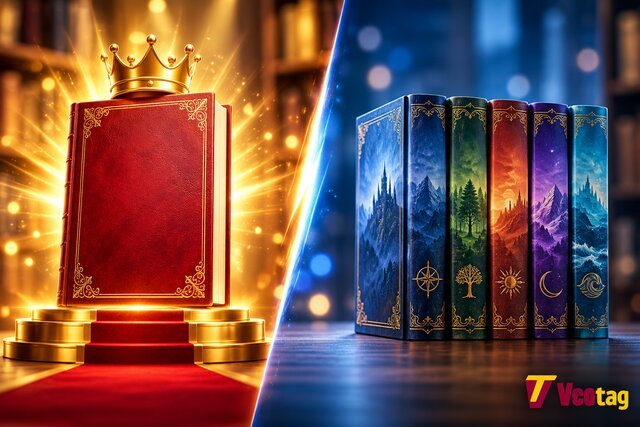
An individual book and a book series are two different measurements.
Harry Potter and the Philosopher’s Stone, for example, is a single novel. The Harry Potter series includes seven main novels, so total series sales naturally exceed the sales of its first installment.
The same issue arises with Tolkien. The Hobbit is a standalone title, while The Lord of the Rings is often published as either one volume or three volumes. Depending on how a source counts editions and volumes, rankings can produce apparently conflicting figures.
Readers comparing bestseller lists should therefore check whether the source is measuring individual titles, multi-volume works, or complete franchises.
Does “Best-Selling” Mean “Most Popular”?
Not necessarily.
Copies sold provide one measure of commercial reach, but they do not capture every form of readership. Library borrowing, secondhand books, free digital editions, classroom copies, inherited books, and free distributions can allow millions of additional people to read a title without creating a new retail sale.
Age also gives older books an advantage in lifetime rankings. A book published in 1859 has had far more time to accumulate readers than one published in 2020.
Conversely, modern books benefit from global distribution networks, online retailers, ebooks, audiobooks, social media, international marketing, and faster translation. Comparing books from different centuries therefore reveals cultural reach, but it is not a perfectly controlled measure of popularity.
What Makes a Book Sell Hundreds of Millions of Copies?
There is no single formula. The books at the top of lifetime bestseller lists succeeded for very different reasons.
Longevity is one major factor. Dickens, Carroll, and Tolkien have remained available across generations. International translation is another. Books such as The Little Prince and The Alchemist reached readers far beyond their original languages.
Adaptations can introduce a book to new audiences, while schools and universities can keep classics in circulation. Series can create powerful network effects, as readers who discover one installment often purchase the rest.
Perhaps the clearest pattern is continued relevance. Books capable of finding new readers decades after publication have an enormous advantage over titles that experience a short period of intense popularity and then disappear.
Religious Books Require a Separate Comparison
Religious works are difficult to compare directly with conventional commercial books because their publication and distribution models are fundamentally different.
The Bible provides the clearest example. Guinness World Records identifies it as the world’s best-selling book and reports an estimated 5 to 7 billion copies printed and distributed.
However, many copies have been distributed by churches, missionary organizations, charities, and other groups rather than purchased through ordinary retail channels. Multiple publishers have also printed the text over centuries.
Other religious texts create similar measurement problems. Consequently, a statement such as “the best-selling novel” or “the best-selling commercially published individual book” can have a different answer from the broader question, “What is the best-selling book of all time?”
How to Read Claims About Book Sales
A surprisingly useful way to evaluate bestseller claims is to ask what exactly the number measures.
A strong sales claim should ideally identify the book, measurement period, geographic scope, whether the number represents sales or distribution, and the organization responsible for the estimate.
Be more cautious when an article gives an extremely precise lifetime number for a centuries-old book without explaining where the figure came from.
For modern books, publishers, authors, established publishing organizations, and well-documented industry sources can provide stronger evidence. For historical works, ranges and qualified estimates are often more credible than exact totals.
Conclusion
The best-selling books of all time reveal both the extraordinary reach of publishing and the difficulty of measuring it across centuries. The Bible occupies a category of its own, with Guinness World Records citing an estimated 5 to 7 billion copies printed and distributed. Among conventional individual titles, A Tale of Two Cities, The Little Prince, The Alchemist, Harry Potter and the Philosopher’s Stone, And Then There Were None, Dream of the Red Chamber, and The Hobbit are among the works most consistently associated with extraordinary lifetime sales.
The key qualification is that historical book sales are estimates. Figures for older works, particularly claims surrounding Don Quixote, should not be treated with the same certainty as modern publisher-reported sales. The most useful bestseller ranking is therefore not simply the one with the biggest numbers. It is the one that explains what those numbers represent, where they came from, and how confidently they can actually be measured.
Explore more insightful and valuable content on our blog VeoTag.com! Stay updated with helpful tips, expert advice, and in-depth articles that enhance your knowledge.
FAQ’s
The Bible holds the Guinness World Records designation for the best-selling book of all time. Guinness cites research estimating approximately 5 to 7 billion copies printed and distributed.
There is no universally agreed answer because historical sales estimates vary. A Tale of Two Cities is commonly credited with more than 200 million copies, while some lists claim Don Quixote reached approximately 500 million. The latter estimate is difficult to verify because the book has circulated for more than four centuries.
Yes. Harry Potter and the Philosopher’s Stone has sold more than 120 million copies according to Sotheby’s, placing the first Harry Potter novel among the world’s highest-selling individual books.
Agatha Christie’s And Then There Were None is generally regarded as one of the world’s best-selling mystery novels, with widely cited estimates of approximately 100 million copies.
Lifetime sales data are incomplete, particularly for old and public-domain works. Different sources may also count translations, editions, multi-volume works, distributed copies, or entire series differently. As a result, many historical bestseller numbers are estimates rather than audited totals.
Not necessarily. Sales do not count every reader. A single copy can be borrowed, shared, inherited, resold, or read by multiple people. Free distribution can also create enormous readership without generating conventional retail sales.
Read Also: Top Trends in E-learning 2022
