

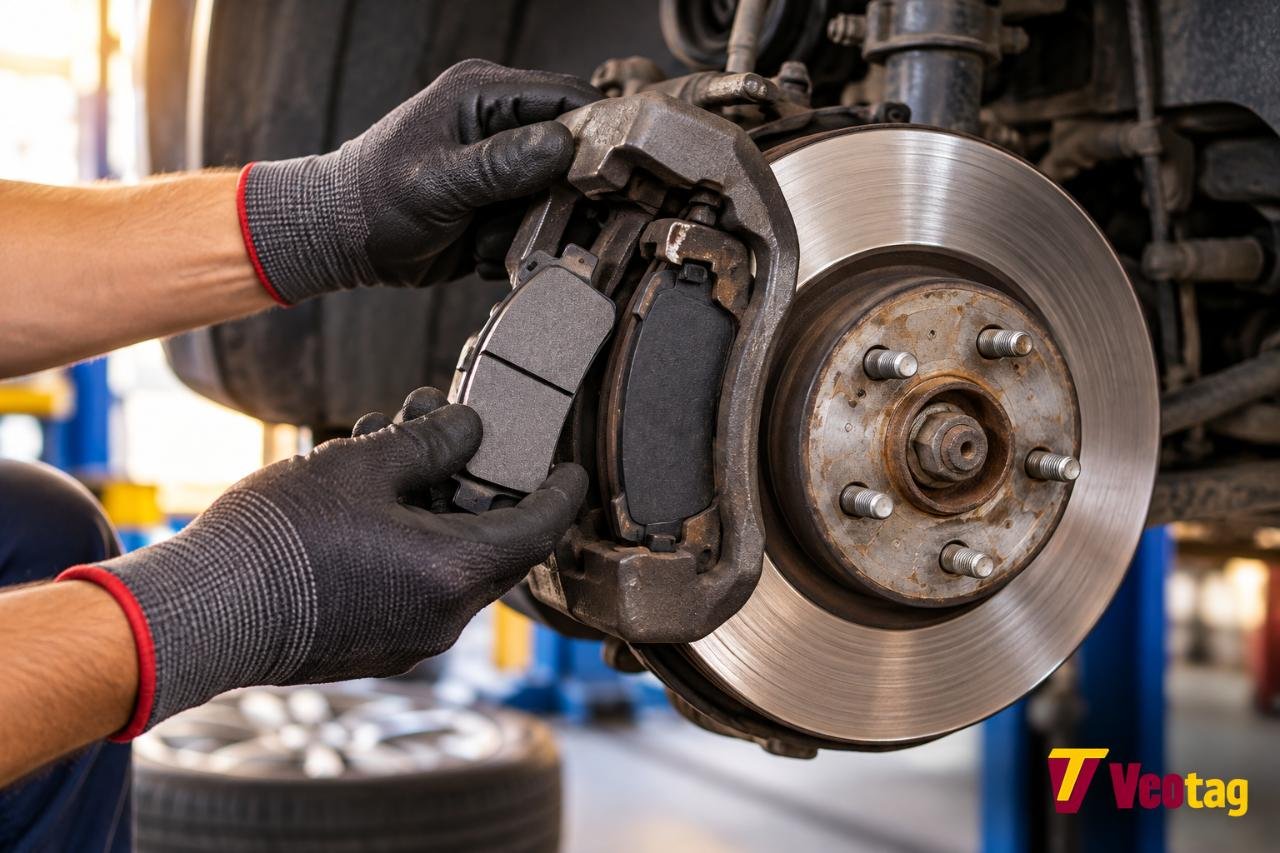
Brake pad replacement should be based on pad thickness and brake condition rather than mileage alone. Brake pads wear at different rates depending on driving habits, traffic, terrain, vehicle weight, and pad material. Around 3 mm of remaining friction material is a common replacement point, although the vehicle manufacturer’s specifications should be followed.
How Do You Know When Brake Pads Need Replacement?
Brake pads gradually become thinner every time they press against the brake rotors. Some vehicles use electronic wear sensors, while other pads have mechanical wear indicators designed to produce a noticeable squeal as the friction material approaches its service limit.
Common warning signs include:
| Warning sign | What it may indicate | Recommended response |
| Persistent squealing or squeaking | Pad wear indicator contacting the rotor, glazed pads, or another brake issue | Schedule a brake inspection |
| Grinding when braking | Friction material may be severely worn, allowing metal components to contact the rotor | Avoid unnecessary driving and inspect immediately |
| Brake-pad warning light | Electronic wear sensor has detected worn pads on equipped vehicles | Arrange inspection and replacement |
| Longer stopping distance | Brake wear, overheating, tire problems, hydraulic issues, or another fault | Have the braking system inspected promptly |
| Steering wheel or pedal vibration | Rotor irregularity, brake deposits, or another brake/suspension problem | Inspect pads and rotors |
| Vehicle pulls during braking | Uneven braking force, seized components, tire issues, or other faults | Professional diagnosis recommended |
| Pads near 3 mm thick | Friction material is approaching a commonly used replacement point | Compare with the manufacturer’s wear specification |
A harsh grinding sound deserves particular attention. Brake pads that have lost their friction material may allow the metal backing plate to contact the rotor, potentially damaging a component that might otherwise have remained serviceable. Firestone likewise identifies roughly 3 to 4 mm as a common range at which replacement should be considered.
Noise alone, however, does not prove that the pads are worn out. Moisture, rust, brake dust, pad compounds, contamination, and temperature can also cause temporary noises. A visual inspection provides a more reliable answer.
How Long Do Brake Pads Last?
Many brake pads last tens of thousands of miles, but there is no single replacement interval that applies to every vehicle.
Kelley Blue Book notes that pads commonly last roughly 25,000 to 50,000 miles, while Firestone cites manufacturer ranges extending approximately 25,000 to 65,000 miles. These figures are useful planning ranges, not automatic replacement schedules.
Several factors can shorten or extend pad life.
City Driving
Stop-and-go traffic requires repeated braking, so a vehicle driven primarily in a city may consume pads faster than one covering similar mileage on open highways.
Driving Style
Frequent hard stops generate more friction and heat. Looking farther ahead, maintaining reasonable following distances, and slowing progressively when conditions allow can reduce unnecessary pad wear.
Hills and Mountain Roads
Repeated downhill braking creates considerable heat. Vehicles regularly driven in steep terrain may need brake inspections more frequently than vehicles used on flat roads.
Vehicle Weight and Loads
Heavy SUVs, trucks, towing vehicles, and cars carrying substantial loads require more braking force to slow down. That additional energy can accelerate pad and rotor wear.
Brake Pad Material
Organic, semi-metallic, low-metallic, and ceramic formulations have different characteristics for noise, heat tolerance, dust, braking response, and wear. A pad designed primarily for quiet operation may behave differently from one designed for towing or performance driving.
Front Versus Rear Brakes
The front brakes often handle a substantial portion of the work during deceleration because vehicle weight transfers forward. As a result, front pads may wear faster on many vehicles.
That is not a universal rule. Modern electronic brake distribution systems, stability-control operation, regenerative braking, and vehicle-specific brake designs can change the wear pattern.
How Much Does Brake Pad Replacement Cost?
Brake pad replacement prices vary considerably by vehicle, location, labor rate, pad type, and whether other brake components need attention.
Kelley Blue Book currently describes typical pad replacement at roughly $150 to $300 per axle, depending partly on pad material and vehicle requirements. RepairPal’s current estimator places the overall average at approximately $335 to $394, illustrating how published estimates can differ depending on the vehicles, labor assumptions, and data used.
A useful budget looks like this:
| Service | Typical cost impact | What changes the price |
| Brake pads only | Lowest-cost brake service | Vehicle, labor rate, pad material |
| Premium or performance pads | Higher | Specialized friction compounds |
| Pads plus rotors | Significantly higher | Rotor size, material, labor |
| Pads plus seized/damaged caliper | Higher again | Caliper design and parts cost |
| Luxury/performance braking system | Potentially much higher | Large rotors, multi-piston calipers, specialized components |
These figures should be treated as U.S. planning estimates rather than quotes. A repair estimate should identify which axle is being serviced, the parts being installed, labor charges, and whether rotors or additional hardware are included.
One common source of confusion is an advertisement for inexpensive brake pads that does not represent the installed price. The part itself may be inexpensive while labor, hardware, sensors, rotor service, shop fees, and vehicle-specific components raise the final bill.
Should Brake Pads Be Replaced on Both Sides?
Yes. Brake pads should normally be replaced as an axle set, meaning both front wheels or both rear wheels are serviced together.
Installing new pads on only one wheel can create uneven braking characteristics and does not address the reason one side wore differently in the first place.
If one wheel has dramatically less friction material than the opposite wheel on the same axle, the difference deserves investigation. Possible causes include a sticking caliper piston, seized or poorly lubricated slide pins, damaged hardware, or other mechanical problems.
RepairPal also describes brake pad replacement as a paired service on the corresponding axle.
Do You Need New Rotors Every Time You Replace Brake Pads?
Not necessarily.
Brake pads usually wear faster than rotors, so replacing pads does not automatically mean the rotors must also be replaced. The rotors should nevertheless be inspected whenever the pads are serviced.
Pads alone may be appropriate when the rotor:
- remains above its manufacturer’s minimum thickness;
- has a suitable braking surface;
- does not have serious scoring or cracking;
- has no condition that makes it unsuitable for reuse.
Brembo states that pads can be replaced without replacing the discs when the discs remain within their allowable wear limits. When brake discs themselves are replaced, however, new pads should be fitted with them.
Each rotor has a minimum allowable thickness specified for that component. Measuring the rotor and comparing the result with that specification is more reliable than deciding based only on appearance.
Deep grooves, excessive wear, cracking, severe corrosion, or other damage can make replacement necessary.
What Happens During a Brake Pad Replacement?
Although procedures vary by vehicle, a typical professional brake pad service involves more than simply removing one component and installing another.
The technician generally:
- Raises and safely supports the vehicle.
- Removes the wheels.
- Inspects the pads, rotors, calipers, hoses, and related hardware.
- Removes the brake caliper as required by the vehicle design.
- Removes the old pads.
- Checks rotor condition and thickness.
- Services or replaces appropriate brake hardware.
- Retracts the caliper piston using the correct procedure.
- Installs the new pads.
- Reassembles the brake components.
- Reinstalls the wheels and torques the fasteners to specification.
- Restores proper pedal pressure and verifies brake operation.
RepairPal similarly specifies rotor inspection as part of the brake-pad replacement process because rotor condition affects how the new pads perform.
Some newer vehicles require additional procedures. For example, rear brakes with an electronic parking brake may need a diagnostic or service mode before the caliper pistons can be retracted safely.
Can You Replace Brake Pads Yourself?
Brake pad replacement is possible for an experienced DIY mechanic with the correct tools, repair information, and safe lifting equipment. It is not a good job for improvisation because the braking system directly affects vehicle safety.
At minimum, a DIY repair requires the correct:
- brake pads for the vehicle;
- jack and properly rated jack stands or another approved lifting system;
- hand tools;
- torque wrench;
- caliper piston tool where required;
- brake-cleaning supplies;
- vehicle-specific service information.
Never work underneath or around a raised vehicle supported only by a portable jack.
The vehicle’s service procedure also matters. Caliper fastener torque, wheel-fastener torque, electronic parking-brake procedures, hardware placement, lubrication locations, and brake-piston retraction methods can differ substantially between vehicles.
If you are uncertain about any of these steps, professional service is the safer option.
Ceramic vs. Semi-Metallic vs. Organic Brake Pads
The best replacement pad is usually one that meets the vehicle manufacturer’s performance requirements and suits how the vehicle is used.
| Pad type | Typical characteristics | Often suited to |
| Ceramic | Quiet, relatively low dust, smooth everyday operation | Many passenger cars and daily drivers |
| Semi-metallic | Strong heat tolerance and braking performance, potentially more noise or dust | Trucks, heavier vehicles, demanding use |
| Organic | Generally quiet and inexpensive but may wear faster under demanding conditions | Certain lighter-duty applications |
These categories describe broad tendencies, not guarantees. Friction formulations vary considerably between manufacturers.
A driver who regularly tows, descends steep grades, or uses a performance vehicle should avoid selecting pads solely because they produce less dust or cost less. The pad must be appropriate for the braking system and intended operating conditions.
Why New Brake Pads Sometimes Still Make Noise
Replacing worn pads does not guarantee completely silent brakes.
New brakes can squeak because of:
- rotor surface condition;
- incorrect or missing hardware;
- pad vibration;
- contamination;
- incompatible pad and rotor surfaces;
- corrosion;
- improper installation;
- friction-material characteristics.
This is one reason rotor inspection matters during a pad replacement.
New pads may also require a bedding or break-in process so their friction material establishes an appropriate contact layer against the rotor. The correct procedure depends on the pad and vehicle, so follow the brake-pad manufacturer’s or vehicle manufacturer’s instructions rather than assuming every pad uses the same break-in routine.
Persistent grinding, strong vibration, pulling, overheating, or noticeably poor braking after service should not be treated as normal break-in behavior.
How to Make Brake Pads Last Longer
Drivers cannot prevent brake-pad wear, but they can reduce unnecessary wear.
Leave enough following distance to slow progressively instead of making frequent abrupt stops. In hilly areas, use appropriate transmission or engine-braking techniques where the vehicle manufacturer permits them rather than continuously riding the brake pedal downhill.
Vehicle condition matters too. A sticking caliper can keep a pad in contact with the rotor even when the brake pedal is released. That can rapidly wear one pad, overheat the brake, and sometimes produce a burning smell or unusually hot wheel.
Regular inspections can catch this type of problem before a routine pad replacement becomes a larger brake repair.
Brake Pad Replacement on Hybrid and Electric Vehicles
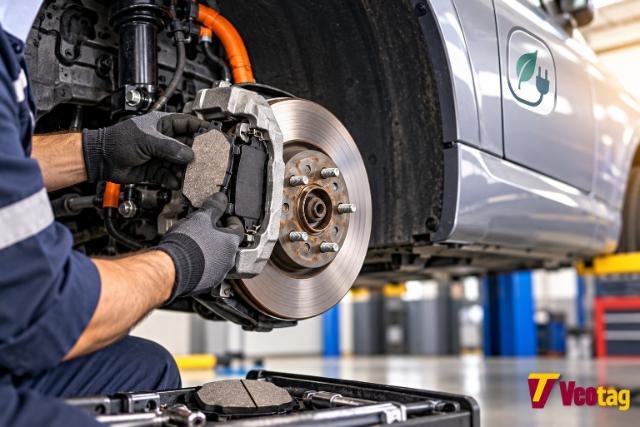
Electric vehicles and hybrids add an interesting complication to brake maintenance.
Regenerative braking can use the electric motor to slow the vehicle and recover energy. Because the conventional friction brakes may perform less work, their pads can potentially last longer than those on a comparable combustion-engine vehicle.
Less friction-brake use does not eliminate maintenance, however. Brembo notes that reduced use of conventional brakes on EVs and plug-in hybrids can contribute to corrosion on brake-disc surfaces.
An EV that still has substantial brake-pad thickness may therefore need attention for corrosion, sticking components, or rotor condition. Inspection remains more useful than assuming long pad life means the entire braking system is maintenance-free.
When Brake Problems Require Immediate Attention
Some brake symptoms should be treated differently from ordinary pad wear.
Arrange prompt professional inspection if:
- the pedal suddenly feels unusually soft or sinks toward the floor;
- stopping ability has noticeably decreased;
- the vehicle strongly pulls during braking;
- grinding is severe or continuous;
- brake fluid appears to be leaking;
- a brake-system warning light accompanies abnormal braking;
- a wheel becomes unusually hot after ordinary driving.
These symptoms can involve components beyond the pads, including the hydraulic system, calipers, hoses, master cylinder, rotors, or other braking hardware.
A worn pad is routine maintenance. A braking system that is not functioning normally is a safety issue.
Brake Pad Replacement Checklist
Before approving a brake job, ask for enough information to understand what is actually being replaced.
A useful brake inspection should answer:
- How much friction material remains on the front pads?
- How much remains on the rear pads?
- Are both sides of each axle wearing evenly?
- Are the rotors above their minimum thickness?
- Are the rotor surfaces reusable?
- Are any calipers or slide mechanisms sticking?
- Are wear sensors or brake hardware being replaced?
- What brand and type of brake pads will be installed?
- Does the quoted price cover one axle or the entire vehicle?
- Are labor, parts, shop charges, and taxes clearly identified?
These questions are particularly useful when comparing estimates. Two brake-service quotes that appear very different may actually include different parts and amounts of work.
Conclusion
Brake pad replacement should be based primarily on actual brake condition, not an arbitrary mileage number. While many pads last tens of thousands of miles, traffic, vehicle weight, terrain, driving habits, friction material, and braking-system design can dramatically change their lifespan.
Around 3 mm of remaining friction material is a widely used point for considering replacement, but the vehicle manufacturer’s specification is the final reference. When pads are changed, the rotors, calipers, hardware, and wear pattern should also be checked.
Replacing worn pads before they reach metal-to-metal contact usually keeps the repair simpler and protects the rest of the braking system. If braking performance has changed, the pedal behaves abnormally, or grinding has begun, treat the issue as a brake-system inspection rather than assuming it is only a routine pad replacement.
Read Also:
- Mercedes Vito Tourer: Practical Guide to Seating, Dimensions, Engines and Everyday Use
- Morgan Super 3: Specs, Price, Performance, Driving Experience and Buying Guide
FAQ’s
Driving with slightly worn pads is different from driving with pads that have reached or passed their service limit. Once the friction material becomes excessively thin, braking performance can deteriorate and rotor damage can become more likely. Grinding, major changes in braking, or a brake warning should be investigated promptly.
Around 3 mm of remaining friction material is a commonly cited replacement threshold. Brembo recommends replacement at approximately this thickness, but the exact specification for the vehicle and pad should take priority.
Not necessarily. Front and rear pads may wear at different rates. Pads should normally be replaced in pairs across the same axle, but replacing the front pads does not automatically require replacing the rear pads if the rear set remains safely within specification.
The time varies by vehicle and by what the inspection finds. A straightforward pad replacement can be relatively quick, while seized fasteners, electronic parking brakes, damaged rotors, worn hardware, or caliper problems can increase the labor required.
Grinding can occur when friction material has worn away enough for metal components to contact the rotor, although other brake problems can also produce harsh noises. Because continued metal-to-metal contact can damage the rotor, grinding brakes should be inspected promptly.
Mileage alone is not the deciding factor. Before a long journey, especially one involving mountain roads, towing, or heavy loads, check remaining pad thickness and overall brake condition. Pads that are already close to their service limit may be worth replacing before the trip rather than depending on them for demanding driving.
