

Most delivery failures don’t occur on the road. They occur at the loading dock, the lobby desk, or the parking bay that fits exactly one van – and yours pulls up second.
Understanding that makes a big difference when you’re attempting to accommodate late order alterations without causing the rest of your schedule to implode. Because it’s not just the additional stop that’s at risk. It’s the additional stop at a facility that eats up 25 minutes before a driver can even start unloading.
Why one change breaks everything downstream
One unplanned stop is theoretically not a problem. But in practice, it’s hardly easy to do. Each route is designed around time windows – promises you’ve made to customers about delivery times. They’re tight because your route optimization software made them that way. A new stop is thrown onto your 11 am route already in progress. That one delivery isn’t postponed; every delivery after it is postponed. The original route had three more deliveries after the unplanned one. Now, every one of those last-mile deliveries is in danger.
According to a study by Convey (now part of project44), 69% of shoppers say they are less likely to shop with a retailer again after a single late delivery. One bad day compounds into lost customers.
The building problem no one talks about
Navigation tools can estimate the time a delivery will take. But they can’t predict how long the driver will be detained by parking, or how long the wait will be when he gets there. A residential address is one thing. But commercial deliveries – office towers, hospital facilities, apartment complexes, industrial estates – each come with their own friction. Gate codes that have changed. Loading docks that are first-come, first-served. Security desks that require paperwork before they’ll accept anything.
Give your driver an extra address, and he’s probably going to be late for more than just that one customer. Because dwell time is so hard to shave, a new address can represent up to half an hour of delay. And that 30 minutes is just the increase. It will affect all subsequent delivery times too.
This is why reacting to order changes needs more than a map update. It needs a system.
Why manual coordination falls apart under pressure
When something changes – a customer tacks on a stop, an address is updated, a receiver isn’t home and needs to be shifted to a different route – dispatchers with spreadsheets and phones are attempting to make a real-time, multi-variable decision.
They’re looking at where drivers were 5 minutes ago. They’re calling drivers, hoping to time the call between stops but often pulling their focus when they’re at a delivery. They’re trying to eyeball which driver is nearest and which route can absorb an extra stop without going over time, without knowing how those shifts affect downstream stops on other routes.
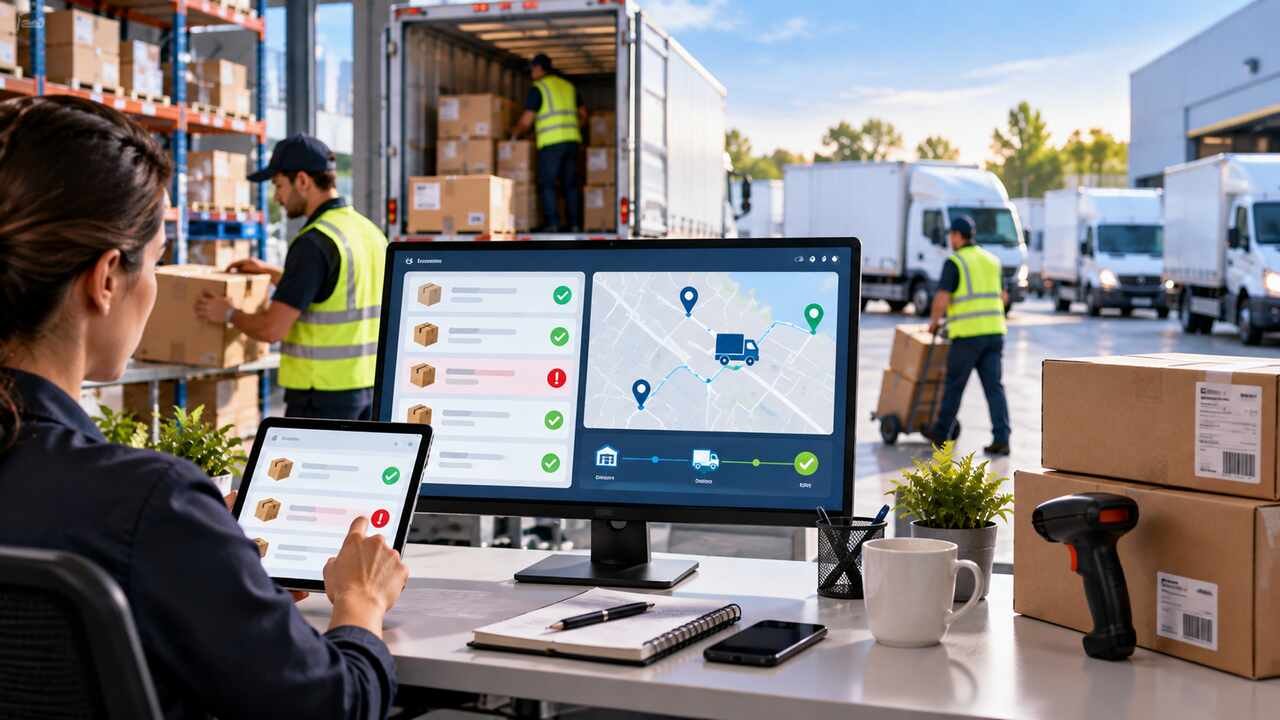
Every quick switch is a potential new conflict. A courier management system automatically accounts for the most efficient rearrangement – it sees all active routes simultaneously, calculates where the new stop fits with the least added mileage, and pushes the updated sequence directly to the driver without anyone making a call.
That’s not just faster. It removes a category of human error that compounds under pressure.
What the driver actually needs at the point of change
The driver’s mobile app is the point of truth for the delivery. If a route changes during a shift, there is no point in having that information only in one of the dispatcher’s spreadsheets or inside the dispatcher’s head.
Drivers need the new stop details – address, contact name, access notes if available. Drivers need the updated route sequence so they’re not making judgment calls about order. And drivers need any revised proof of delivery requirements, because the documentation for an added stop may be entirely different from what you usually require.
If those three things arrive in the driver’s mobile app all in one interface, they can absorb the change and move. If they arrive as a phone call followed by a text followed by another call, you’ve just burned five minutes of dwell time.
Keeping customers informed when the plan shifts
When an order change ripples through a route, customer ETAs change. Most support calls don’t come from customers who got a late delivery. They come from customers who didn’t know the delivery was going to be late until they’d already waited past the window.
Automated ETA recalculation solves this. When the system re-optimizes a route, it can push updated arrival windows to affected customers immediately – before they start wondering. That one automated message deflects a support call, manages the customer’s expectation, and keeps the driver from arriving at a door with no one there to receive the package.
Bringing it together
There will always be last-minute changes. The key is not to let them derail the whole day. A driver makes the wrong turn, a regular receiver changes their appointment time, a must-have delivery comes in that must be squeezed in. That means treating the building as part of the route problem, not just the destination. It means removing manual coordination from the re-routing process before it creates new conflicts. And it means making sure drivers, dispatchers, and customers are all looking at the same updated reality the moment anything shifts. The road is solvable. The building, and the chaos of a mid-route change, takes a system built to handle both.
Read Also: Why the Rise of Smart Buildings Requires a Complete Rethink of Physical Access Control
