





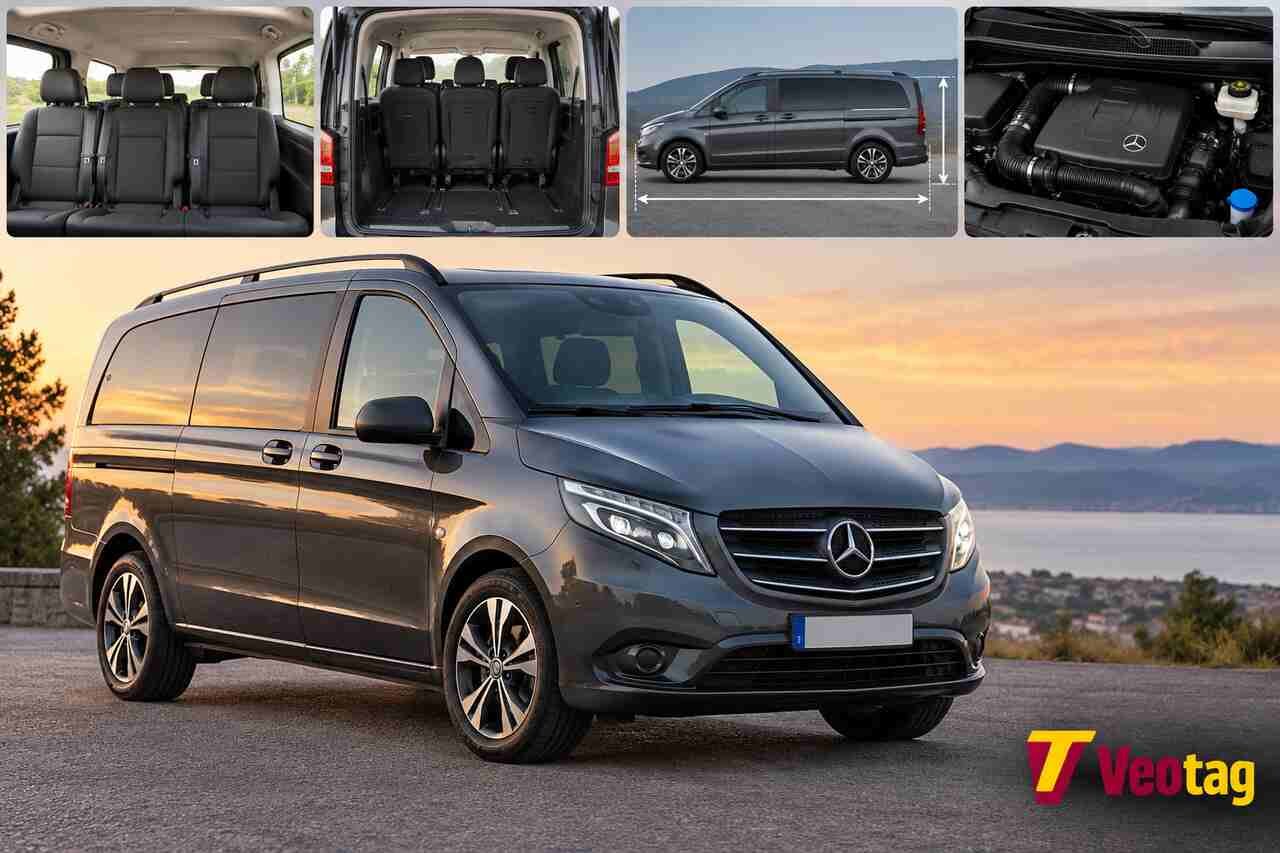
The Mercedes Vito Tourer is a versatile people carrier that can seat up to nine people while offering flexible seating and generous luggage space. Designed for families, businesses, airport transfers and private-hire services, it combines passenger practicality with modern technology and driver-assistance features.
Mercedes Vito Tourer at a Glance
The easiest way to understand the Vito Tourer is to distinguish it from the other vehicles carrying the Vito name. The Panel Van prioritises cargo, while the Crew model combines passenger accommodation with a larger dedicated load area. The Tourer is primarily configured around carrying people.
For the current UK-market vehicle, some of the most useful specifications are:
| Feature | Mercedes Vito Tourer |
| Maximum seating | Up to 9 people |
| Available lengths | Long and Extra-Long |
| Long version length | 5,140 mm |
| Extra-Long version length | 5,370 mm |
| Approximate vehicle height | 1,909 to 1,914 mm including aerial |
| Maximum boot capacity | Up to 1.7 m³ |
| Maximum towing capacity | Up to 2.5 tonnes, configuration dependent |
| Current UK diesel outputs | 136 hp or 163 hp |
| Transmission | 9G-TRONIC automatic |
| Current UK trim lines | PRO and SELECT |
Specifications can differ between countries and configurations, so buyers should check the specification sheet for their particular market rather than assuming every Vito Tourer has the same equipment or drivetrain.
How Many Seats Does a Mercedes Vito Tourer Have?
A Mercedes Vito Tourer can provide seating for up to nine people, including the driver. Its flexible seat mountings allow different combinations of individual seats and two-seat or three-seat benches, with configurations ranging from two to nine seats on current UK models.
This flexibility matters because maximum seating capacity is not necessarily the best configuration for every owner. An airport-transfer operator, for example, has to consider where several large suitcases will go when most passenger seats are occupied. A family may instead prioritise generous space between rows, easier access and room for pushchairs or holiday luggage.
Child-seat requirements deserve similar attention. Mercedes-Benz states that up to four child seats can generally be secured using ISOFIX in the Vito Tourer, although the exact possibilities depend on the installed seating arrangement.
For buyers specifically searching for a Mercedes Vito 8 seater or 9 seater, it is therefore worth checking the actual seating layout of the individual vehicle, particularly when shopping used. Two vehicles of the same length and model year may have been configured differently.
Mercedes Vito Tourer Dimensions and Interior Space

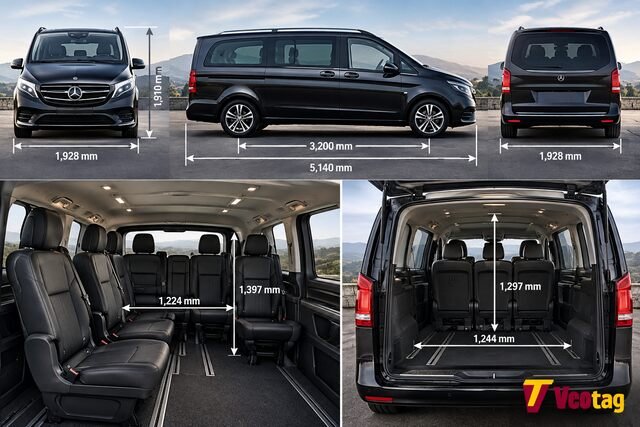
Current UK Vito Tourer models are available in Long and Extra-Long versions. The Long model measures 5,140 mm, while the Extra-Long version reaches 5,370 mm. Mercedes-Benz lists the vehicle height at approximately 1,909 to 1,914 mm including the aerial, depending on the variant.
The length decision has practical consequences. A longer vehicle can be particularly useful when passengers and luggage regularly need to travel together, while a shorter version may be easier to manoeuvre and park.
That trade-off can be considered this way:
| Requirement | Long | Extra-Long |
| Urban manoeuvrability | Better choice | Requires more space |
| Large passenger groups | Suitable | Particularly useful |
| Passenger plus luggage requirements | Good | Greater flexibility |
| Tight parking spaces | Easier | More planning required |
| Hotel/airport transfers | Suitable | Often attractive for luggage-heavy journeys |
These are practical distinctions rather than guarantees about a particular vehicle’s cargo capacity. Seat arrangement and individual specification also affect usable space.
One dimension that deserves particular attention is height. At under roughly two metres in standard configurations, the Vito Tourer may fit into many multi-storey car parks, but drivers should never assume clearance from the nominal vehicle height alone. Roof accessories, suspension, tyres, loads and car-park restrictions can affect real-world clearance.
Engines, Transmission and Driving Characteristics
Current UK Vito Tourer specifications list diesel engines at 136 hp for PRO and 163 hp for SELECT, paired with the 9G-TRONIC nine-speed automatic transmission. Current UK Tourer variants are rear-wheel drive.
Mercedes-Benz has offered a broader selection of engines and drivetrains across the wider Vito range and in other markets, so used buyers may encounter specifications that differ significantly from today’s UK catalogue. Previous and market-specific versions can include different outputs and all-wheel-drive configurations.
For a buyer, outright power is only one consideration. A vehicle that regularly carries several adults and their luggage places different demands on its powertrain than one predominantly driven with two or three occupants. Motorway use, gradients, annual mileage and towing requirements should therefore influence the engine choice.
The Vito Tourer can also provide towing capability of up to 2.5 tonnes, depending on the individual vehicle configuration. Anyone buying specifically for towing should check the permitted towing weight on that exact vehicle rather than treating the maximum figure as universal.
Interior Comfort and Technology
The current Mercedes Vito Tourer moves beyond the basic interior associated with traditional passenger vans. Its available equipment includes the MBUX multimedia system, multifunction steering wheel, smartphone integration and numerous storage solutions.
That equipment becomes especially relevant when the vehicle is used professionally. Drivers operating airport transfers or shuttle services may spend many hours behind the wheel, while passengers judge the vehicle partly on accessibility, cabin comfort and refinement.
Available convenience equipment can include the EASY-PACK package, which provides electrically operated functionality for relevant doors or the tailgate. A digital rear-view mirror is another notable option because passengers or luggage can otherwise obstruct a conventional mirror’s rearward view.
Optional equipment should still be evaluated according to use rather than simply adding everything available. Powered access features can be particularly valuable for frequent passenger pickups, whereas other buyers may place greater value on parking assistance or upgraded lighting.
Safety and Driver-Assistance Features
The Vito Tourer combines its passenger-carrying role with a substantial collection of modern assistance systems. Current UK standard equipment includes Active Brake Assist, Active Lane Keeping Assist, Blind Spot Assist, Intelligent Speed Assist, ATTENTION Assist, cruise control and a reversing camera.
Optional equipment can extend those capabilities. Mercedes-Benz lists technologies such as Active Distance Assist DISTRONIC and Active Steering Assist through the Driving Assistance Package, while a Parking Package with a 360-degree camera is also available.
A 360-degree camera can be particularly useful on a vehicle measuring more than five metres long. It does not remove the need for careful observation, but it can make tight parking areas and passenger pickup points easier to negotiate.
Buyers comparing used Vito Tourers should not assume that a feature available on the current model was fitted to an older vehicle. Driver-assistance technology, standard equipment and option packages vary by year, market and trim.
Mercedes Vito Tourer vs eVito Tourer

Mercedes-Benz also offers an electric passenger-carrying alternative, the eVito Tourer. The electric model retains the basic people-carrier concept while placing its battery beneath the floor, allowing it to accommodate up to eight passengers plus the driver without the electric drivetrain taking over the passenger compartment.
The current UK eVito Tourer uses a 150 kW (204 hp) electric motor driving the front wheels. Mercedes-Benz currently lists a 90 kWh usable battery for the UK model. Published range figures can vary by model specification and testing context, so buyers should use the latest official configurator or specification sheet for the exact vehicle they are considering.
The choice between diesel and electric depends heavily on operating pattern.
| Usage pattern | Vito Tourer diesel | eVito Tourer |
| Long-distance motorway journeys | Strong fit | Requires charging planning |
| Predictable daily shuttle routes | Good | Potentially excellent |
| Access to overnight charging | Not required | Major advantage |
| Unpredictable long-distance work | More convenient | May be less convenient |
| Local passenger transport | Good | Particularly well suited |
| Refuelling/charging time | Faster refuelling | Longer charging stops |
A hotel running repeated airport transfers on a known daily schedule, for example, can calculate its expected mileage and charge the eVito overnight. An operator taking unpredictable long-distance bookings may value the flexibility of diesel more highly.
The right comparison is therefore not simply diesel versus electric purchase price. Annual mileage, electricity costs, diesel costs, charging availability, downtime and expected ownership period all contribute to total operating cost.
Is the Mercedes Vito Tourer Good for Families?
The Vito Tourer can make a compelling family vehicle when conventional seven-seat SUVs or MPVs do not provide enough passenger and luggage space. Sliding side doors are useful in tight parking areas, while the flexible passenger compartment allows owners to adapt the seating arrangement to different journeys.
Its biggest advantage becomes clearer with larger households. A seven-seat car may technically accommodate a large family but leave limited luggage room once every seat is occupied. A purpose-designed people carrier provides a different balance between passenger accommodation and usable interior space.
There are compromises. At more than five metres long in current UK configurations, a Vito Tourer demands more parking space than a typical family car. Running costs, tyres, insurance and servicing should also be compared with those of smaller alternatives before buying.
Families should additionally check the exact ISOFIX locations, seat configuration and accessibility of the particular vehicle rather than focusing only on its advertised maximum seating capacity.
Is the Vito Tourer Suitable for Taxi, Shuttle and Airport Transfer Work?
Passenger transport is one of the Vito Tourer’s natural applications. Mercedes-Benz specifically positions the model for uses including taxi businesses, hotel transfers, shuttle services and airport transportation.
The appeal comes from combining passenger capacity with equipment expected in a modern professional vehicle. Multiple seating configurations allow operators to balance passenger numbers against luggage, while sliding doors can simplify repeated boarding and exiting.
Airport operators should pay particular attention to luggage requirements. Carrying eight passengers is different from carrying eight airline passengers, each potentially arriving with a large suitcase and cabin bag. Choosing a vehicle based solely on its seat count can therefore produce an impractical configuration.
A useful purchasing calculation is:
Typical passengers + typical luggage + required reserve space = realistic operating capacity
If most bookings involve four to six passengers with substantial luggage, maintaining spare cargo capacity may be more valuable than configuring the vehicle for the maximum possible number of occupants.
PRO vs SELECT: Which Vito Tourer Trim Should You Choose?
Current UK Vito Tourers are offered in PRO and SELECT trim levels. The range also differentiates the two with engine output, with Mercedes-Benz currently listing 136 hp for PRO and 163 hp for SELECT.
PRO is likely to appeal to buyers primarily concerned with practical passenger transport and controlling acquisition costs. SELECT makes more sense where additional comfort, appearance or equipment matters, particularly for premium passenger-transfer work.
The decision should ultimately be based on individual equipment rather than the trim badge alone. This is particularly important when buying used, where optional packages can make a well-equipped lower-trim vehicle more suitable than a higher-trim example without the options you need.
What to Check Before Buying a Used Mercedes Vito Tourer
A used Vito Tourer should be evaluated according to how it was previously operated. A privately owned family vehicle and a high-mileage airport shuttle can have very different wear patterns even if their age and specification are similar.
Check the service history, mileage documentation, seating mechanisms, sliding doors, air-conditioning system, infotainment equipment, parking sensors or cameras, tyres and general interior condition. All installed seats should lock securely into their intended positions, and seat belts and child-seat mounting points should be inspected carefully.
Look closely at passenger-area wear. Repeated commercial use can place additional strain on door mechanisms, seat runners, upholstery and interior trim. Conversely, motorway mileage is not automatically worse than a lower figure accumulated through constant short urban trips.
For diesel vehicles, the type of previous use also matters. Modern emissions-control equipment generally benefits from appropriate operating conditions, so understanding whether a vehicle mainly completed long journeys or repeated short trips provides useful context.
Finally, verify the specification from the vehicle itself. Used advertisements sometimes describe seating capacity, trim levels or optional equipment inaccurately.
Who Should Buy a Mercedes Vito Tourer?
The Mercedes Vito Tourer makes the most sense when passenger capacity and flexibility are more important than having the compact footprint of a conventional car.
It is particularly relevant for large families, hotels, chauffeur and private-hire operators, airport-transfer companies, community organisations and businesses regularly transporting groups of people. The ability to accommodate up to nine occupants gives it an advantage where an ordinary seven-seat vehicle is simply too restrictive.
It may be excessive for someone who only occasionally needs additional seats. Buyers who regularly need to transport both a work crew and substantial equipment should also compare the Vito Crew, while those primarily carrying goods will generally be better served by the Panel Van.
Conclusion
The Mercedes Vito Tourer occupies a useful middle ground between a conventional passenger car and a full-size minibus. Its biggest strengths are seating for up to nine people, flexible passenger configurations, two available body lengths and an interior designed around moving groups comfortably.
The best version depends on the job. Families should prioritise seating configuration, child-seat compatibility and everyday parking practicality. Shuttle and private-hire operators should calculate realistic luggage capacity as well as passenger numbers. High-mileage buyers should compare diesel operating costs with the eVito Tourer based on their actual routes and charging access.
Above all, specifications vary by model year, market and configuration. Check the exact vehicle rather than relying on the Vito Tourer name alone, particularly when comparing used examples or vehicles from different countries.
FAQ’s
Yes. The Vito Tourer can be configured to carry up to nine people including the driver. The actual number of seats depends on the individual vehicle’s configuration.
Current UK versions are offered in Long and Extra-Long configurations. Mercedes-Benz lists them at 5,140 mm and 5,370 mm respectively.
It is based on Mercedes-Benz’s Vito commercial-vehicle family but is configured as a passenger-carrying Tourer. Mercedes-Benz describes it as a multi-purpose vehicle and markets it for both professional passenger transport and other people-carrying applications.
Yes. Its flexible seating, sliding doors and capacity for large numbers of passengers can make it particularly useful for larger families. Its size means parking, manoeuvrability and running costs should be considered before choosing it over a conventional MPV or SUV.
Yes. The Mercedes-Benz eVito Tourer provides an all-electric alternative and can accommodate up to eight passengers plus the driver. Current UK specifications use a 150 kW (204 hp) electric motor.
Mercedes-Benz states that the Vito Tourer can provide a maximum towing capacity of up to 2.5 tonnes, depending on configuration. Always verify the permitted towing weight for the specific vehicle before towing.