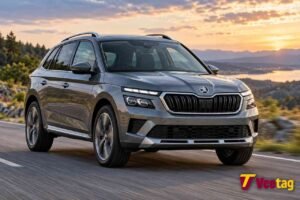




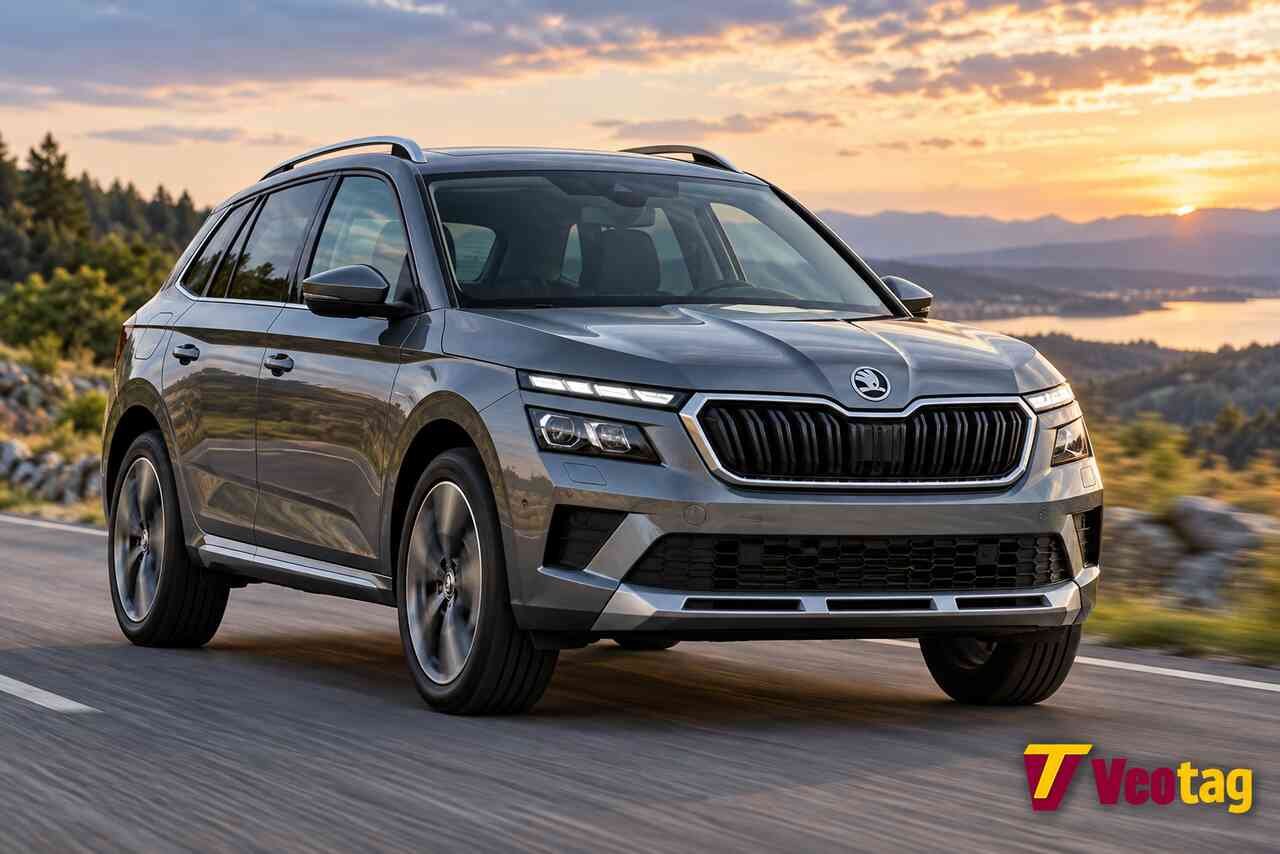
The Skoda Kamiq is a compact SUV that stands out for its spacious interior, comfortable ride and easy-to-use controls. It offers good everyday practicality and strong standard equipment, although its boot is not class-leading, there is no hybrid option, and the DSG automatic can feel less smooth at low speeds.
Skoda Kamiq at a Glance
The Kamiq sits at the smaller end of Skoda’s SUV range. At 4,241 mm long, it occupies roughly the same road space as many family hatchbacks while giving occupants a higher seating position and more SUV-like styling. Its 2,651 mm wheelbase helps explain why the cabin feels more spacious than the exterior dimensions might suggest.
| Specification | Current Skoda Kamiq |
| UK starting price | £25,535 |
| Engine choices | 1.0 TSI 95 PS, 1.0 TSI 116 PS, 1.5 TSI 150 PS |
| Gearboxes | 5-speed manual, 6-speed manual, 7-speed DSG depending on engine |
| Official combined economy | 47.9 to 52.3 mpg |
| CO2 emissions | 122 to 133 g/km, depending on version |
| 0-62 mph | 8.3 to 11.0 seconds |
| Length | 4,241 mm |
| Wheelbase | 2,651 mm |
| Boot space | 400 litres |
| Boot with rear seats folded | 1,395 litres |
| New-car warranty | First 2 years unlimited mileage, third year up to 60,000 miles |
| Euro NCAP | Five stars when tested in 2019, rating expired in January 2026 |
The expiry of the Euro NCAP rating is an important distinction. It does not mean the Kamiq suddenly became unsafe in 2026. It means its 2019 assessment is no longer treated as a current rating under Euro NCAP’s evolving testing standards.
What Is the Skoda Kamiq Like to Drive?

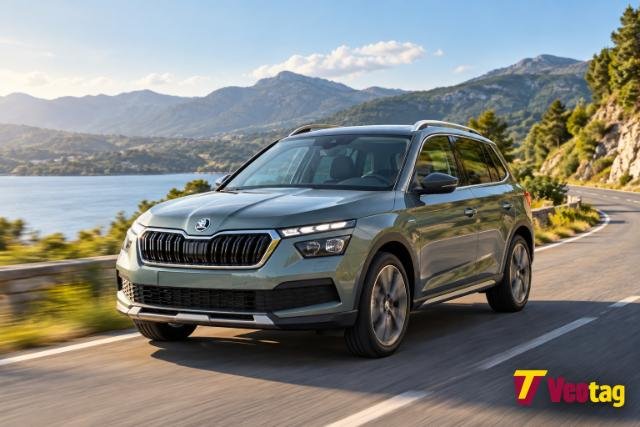
Comfort is one of the Kamiq’s strongest qualities. The suspension is relatively supple for a small SUV, particularly on urban roads and motorways. Steering is light enough for parking and city driving but remains accurate when speed increases. It is designed more around stability and ease of use than sharp cornering responses.
That makes the Kamiq well suited to everyday family use. It does not try to behave like a hot hatchback with extra ground clearance. Instead, the controls are predictable, visibility is useful and the relatively compact body is easy to position on narrow streets.
Motorway behaviour is similarly composed. The Kamiq feels stable at speed and does a good job of isolating occupants from road and wind noise, while its chassis remains comfort-focused without excessive body movement.
The gearbox choice deserves more thought. The six-speed manual fitted to the 116 PS and 150 PS engines has a light, straightforward shift action. The seven-speed DSG automatic is convenient in congestion and responsive once moving, but it can feel hesitant or slightly jerky when pulling away or manoeuvring slowly. That does not make the DSG a poor choice, but anyone considering one should specifically assess low-speed behaviour during a test drive.
Which Skoda Kamiq Engine Is Best?
The 1.0 TSI 116 PS is the most balanced engine for typical Kamiq buyers. It offers noticeably stronger acceleration than the entry-level 95 PS unit without a meaningful official fuel-economy penalty in manual form.
The 1.5 TSI 150 PS makes more sense if you regularly travel with several passengers, spend a lot of time on faster roads or simply want greater overtaking performance. The 95 PS engine is adequate for lower-mileage urban use but is the least convincing option for frequent motorway driving.
| Engine | Torque | Gearbox | 0-62 mph | WLTP combined economy |
| 1.0 TSI 95 PS | 175 Nm | 5-speed manual | 11.0 sec | 50.4 to 52.3 mpg |
| 1.0 TSI 116 PS | 200 Nm | 6-speed manual | 9.7 sec | 50.4 to 52.3 mpg |
| 1.0 TSI 116 PS | 200 Nm | DSG | 10.2 sec | 49.6 to 51.4 mpg |
| 1.5 TSI 150 PS | 250 Nm | 6-speed manual | 8.3 sec | 47.9 to 49.6 mpg |
| 1.5 TSI 150 PS | 250 Nm | DSG | 8.3 sec | 48.7 to 49.6 mpg |
These are official WLTP figures, so actual economy will depend on traffic, temperature, load, wheel size and driving style.
There is also a trim restriction worth knowing before choosing an engine. The 95 PS model is offered with SE Edition and Design Edition specifications. The 116 PS engine is available across the range, while the 150 PS engine is reserved for SE L Edition and Monte Carlo Edition models.
For most buyers, the 116 PS manual is therefore the sweet spot. It reaches 62 mph in 9.7 seconds, produces 200 Nm of torque and officially manages as much as 52.3 mpg without forcing you into one of the most expensive trims.
Interior Quality and Technology
The Kamiq’s dashboard is less theatrical than those in some newer small SUVs, but that simplicity has practical advantages.
Physical controls remain available for important functions such as climate settings, which means routine adjustments do not require several touchscreen presses. That helps make the cabin easy to operate while driving.
The latest UK specification has also removed one of the older Kamiq’s weaknesses: entry-level cars no longer feel particularly basic digitally. The current SE Edition includes a 10.25-inch Virtual Cockpit, a 9.2-inch navigation display, wireless SmartLink, a rear-view camera and metallic paint as standard.
Build quality is generally good, although this is not a premium interior from top to bottom. There are softer materials in prominent areas alongside harder plastics lower in the cabin. That is typical for the segment, but buyers moving from a larger or more expensive SUV should adjust expectations accordingly.
The underlying advantage is usability. The display technology is modern enough for navigation and smartphone integration without forcing every vehicle function onto the screen.
Passenger Space Is One of the Kamiq’s Biggest Strengths
Rear-seat accommodation is where the Kamiq makes a particularly strong case for itself.
The Kamiq provides 73 mm of rear knee room, with 1,003 mm of rear headroom and a long 2,651 mm wheelbase. Adult passengers can therefore sit behind adult front occupants without the cabin feeling unusually cramped for such a compact SUV.
That space is especially useful for families with older children, frequent passengers or bulky child seats. The outer rear positions are the most comfortable, while the centre rear position is less appealing. The Kamiq therefore works better as a roomy four-person car than as something intended to carry five adults regularly.
There are also numerous smaller storage areas around the interior, reinforcing the model’s focus on everyday practicality rather than simply headline boot capacity.
How Big Is the Skoda Kamiq Boot?
Boot capacity is 400 litres with the rear seats upright and 1,395 litres when they are folded. The rear backrests split 60:40, and configurations equipped with the appropriate variable floor can create a flatter loading area.
A 400-litre boot should be enough for ordinary supermarket trips, several cabin-size bags or typical family equipment, but it is not the biggest cargo area in the small-SUV class.
That distinction matters because the Kamiq can initially feel like the obvious practicality champion due to its spacious rear seats. Its real strength is passenger accommodation rather than maximum luggage volume.
For context, the Volkswagen T-Cross offers a larger quoted boot, while the Renault Captur can also provide more luggage capacity depending on rear-seat position and powertrain.
Which Skoda Kamiq Trim Offers the Best Value?
The 2026 UK range consists of SE Edition, Design Edition, SE L Edition and Monte Carlo Edition. Current starting prices are £25,535, £26,660, £28,710 and £30,780 respectively.
SE Edition makes a strong case on value because it includes equipment that previously encouraged buyers toward higher trims. Its 17-inch alloy wheels, full LED headlights, digital instrument panel, 9.2-inch navigation screen, reversing camera and metallic paint cover most everyday requirements.
Design Edition is primarily the choice for someone who prefers its styling. It introduces a contrasting black roof and mirrors, privacy glass, sports seats and different alloy wheels. Those changes make the car look more distinctive but do not radically alter how it functions.
SE L Edition brings more meaningful convenience upgrades, including heated front seats, front and rear parking sensors and keyless entry and start. It is also the first current trim that can be ordered with the 1.5 TSI 150 PS engine. For buyers who want both additional equipment and stronger performance, that combination makes more sense than paying for styling alone.
Monte Carlo Edition sits at the top of the range. It adds features such as Matrix LED headlights, a panoramic glass roof, adaptive cruise control and sportier black exterior detailing. It looks more distinctive, but its £30,780 starting price moves the Kamiq into a part of the market where buyers have a much wider selection of alternatives.
Fuel Economy and Running Costs
Official combined economy across the current range sits between 47.9 and 52.3 mpg. Interestingly, moving from the 95 PS 1.0 TSI to the 116 PS manual does not result in worse quoted maximum consumption. Both can achieve up to 52.3 mpg under the official test procedure.
The 150 PS engine uses slightly more fuel, with official figures starting at 47.9 mpg for the manual. Buyers therefore do not face a huge efficiency penalty for the additional performance, although real-world consumption can vary substantially.
Insurance groups are also relatively modest on less powerful versions. The 95 PS SE Edition sits in group 12E, while more powerful and highly equipped derivatives sit higher. The insurance group is only one factor used to calculate an actual premium.
New UK cars receive a two-year unlimited-mileage warranty followed by a third year of cover up to 60,000 miles, whichever comes first. Skoda also provides 12-year body protection.
Is the Skoda Kamiq Safe?
The Kamiq achieved five stars when Euro NCAP assessed it in 2019. Its scores were 96% for adult occupant protection, 85% for child occupants, 80% for vulnerable road users and 76% for safety assistance.
However, that rating officially expired on 1 January 2026. Buyers comparing the Kamiq with a recently tested rival should therefore avoid treating a 2019 five-star result as directly equivalent to five stars achieved under a newer test protocol. Euro NCAP continually tightens its requirements.
The current car still carries modern assistance equipment. Front Assist, traffic-sign recognition and emergency e-call are among the available features, while higher specifications can add systems such as adaptive cruise control.
How Does the Kamiq Compare With Its Main Rivals?
The Kamiq competes in one of Europe’s busiest parts of the new-car market, so the decision depends heavily on what you value most.
A Volkswagen T-Cross follows a broadly similar petrol-engine formula and offers a larger quoted boot. The Renault Captur is particularly relevant for buyers who want electrification because the current range includes a full-hybrid powertrain, something the Kamiq does not offer.
The Ford Puma is a more driver-focused alternative, while the Kamiq responds with a softer ride and an emphasis on space and everyday convenience.
There is another alternative that did not exist for most of the Kamiq’s life. Buyers who specifically want an electric Skoda can consider the Epiq. Its pricing places it surprisingly close to the Kamiq, although charging access, ownership requirements and individual specifications mean the two cars suit different buyers.
Skoda Kamiq Pros and Cons
The strongest reasons to choose the Kamiq are: generous rear passenger space, a comfortable ride, straightforward dashboard controls, good standard equipment, compact exterior dimensions and a useful 116 PS petrol engine.
The main drawbacks are: a boot that trails some competitors, no hybrid powertrain, DSG low-speed behaviour that deserves checking before purchase, and an older Euro NCAP assessment that is now officially expired.
Is the Skoda Kamiq Worth Buying in 2026?
The Skoda Kamiq is worth considering if your priorities are comfort, passenger room and uncomplicated everyday usability. It succeeds because it feels less compromised than its relatively small exterior dimensions suggest.
The 1.0 TSI 116 PS manual in SE Edition is the strongest all-round combination for many buyers. It provides substantially better acceleration than the 95 PS engine while retaining excellent official economy, and SE Edition already includes navigation, a digital instrument display and a reversing camera. Buyers wanting stronger motorway performance can move to the 150 PS engine, although that also requires stepping up to SE L Edition or Monte Carlo Edition.
The bigger question is whether you specifically want electrification. The Kamiq remains petrol-only in its current listed UK engine range at a time when competitors such as the Renault Captur offer full-hybrid alternatives and Skoda itself now sells the electric Epiq.
For drivers who simply want a conventional petrol small SUV that is comfortable, roomy and easy to understand, the Kamiq still makes a convincing case.
Conclusion
The Skoda Kamiq’s appeal is less about one headline feature and more about how well its strengths fit together. It is compact outside, spacious for passengers, comfortable on the road and unusually straightforward to operate. The well-equipped SE Edition also means buyers do not have to climb far up the range simply to obtain useful technology.
Its 400-litre boot, lack of a hybrid option and occasionally criticised DSG behaviour prevent it from being the automatic choice for every small-SUV buyer. But for someone who wants a practical petrol crossover with generous rear-seat space and few day-to-day complications, the Kamiq remains a highly relevant option in 2026.
Read Also:
- Mercedes Vito Tourer: Practical Guide to Seating, Dimensions, Engines and Everyday Use
- Morgan Super 3: Specs, Price, Performance, Driving Experience and Buying Guide
FAQ’s
No. The Kamiq is Skoda’s smaller conventional petrol SUV and measures 4,241 mm long. It is intended for buyers who want SUV-style seating and practicality without moving into a larger vehicle footprint.
The Kamiq provides 400 litres with the rear seats in use and up to 1,395 litres when they are folded.
The current UK Kamiq engine list consists of 1.0 TSI and 1.5 TSI petrol engines, with no hybrid powertrain listed. Buyers wanting electrification within the broader Skoda range can consider electric alternatives such as the Epiq.
It can be. The 116 PS and 150 PS engines are available with a DSG automatic gearbox as well as manual transmission. The 95 PS entry-level engine is paired with a five-speed manual.
For mixed everyday driving, the 1.0 TSI 116 PS manual provides the strongest balance of performance and economy. It reaches 62 mph in 9.7 seconds and officially returns 50.4 to 52.3 mpg. Drivers who regularly carry heavier loads or spend more time on fast roads may prefer the 150 PS 1.5 TSI.
It received five Euro NCAP stars when tested under the 2019 protocol. That rating officially expired on 1 January 2026, so it should be understood as an older safety assessment rather than a current five-star result under today’s standards.